
Catawba Pottery: Generations of Clay From the Catawba River
Catawba potters still dig clay from riverbank pits, coil their vessels by hand and fire them outdoors. Their craft outlasted land loss and poverty, and it is now a living art.
- When
- 1900
- Where
- Catawba River, Piedmont Carolinas
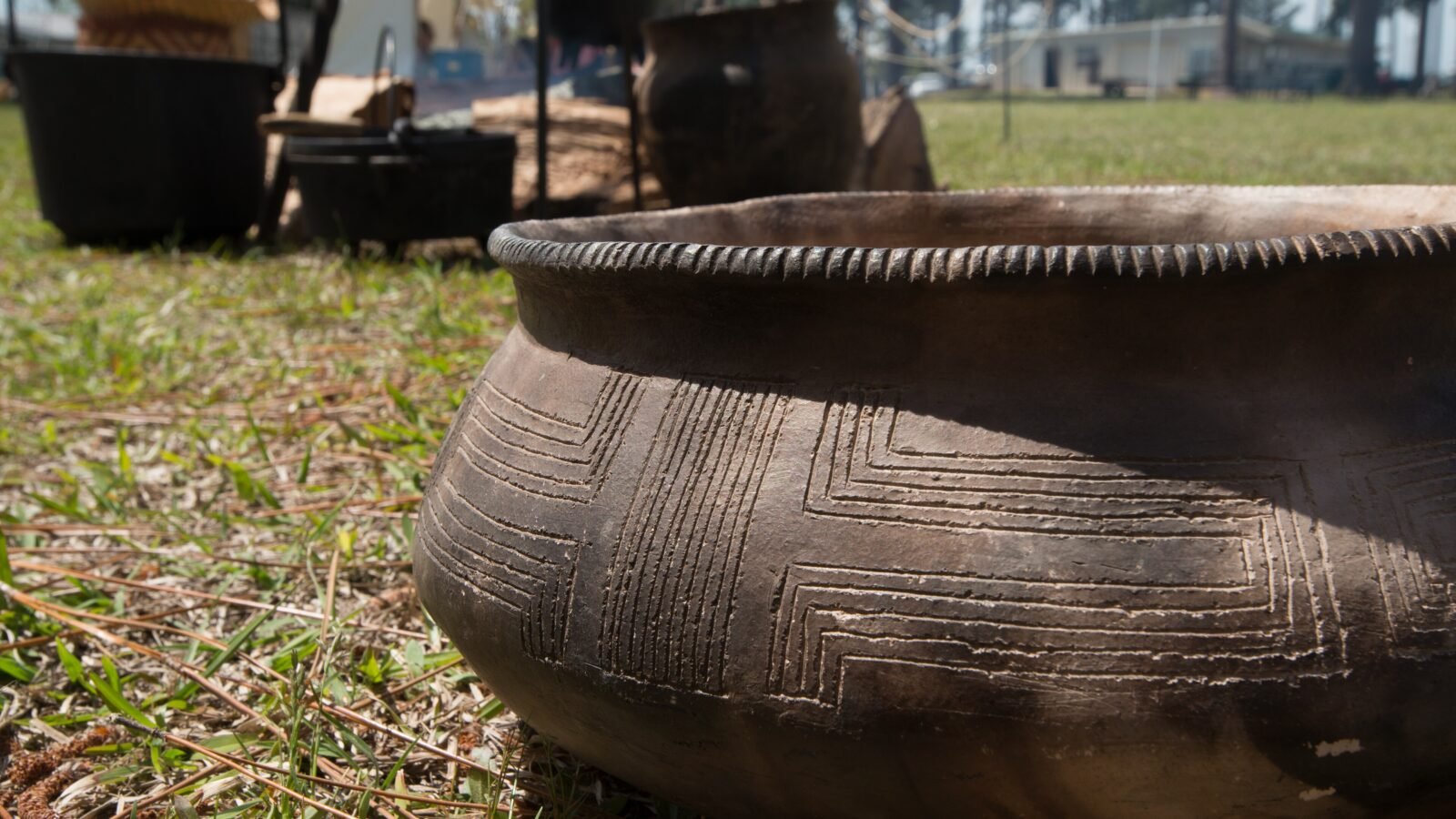
Stand on a riverbank in the Piedmont of the Carolinas and the clay looks ordinary: gray-tan, slick after rain, cut by the current into a bank a few feet high. For Catawba potters, it is the starting material for a craft with written records reaching back to 1702. Catawba potters, men and children among them, still dig it from riverbank pits, work it into coils, shape the walls and fire the finished pots in open fires.
The clay comes from the Catawba River, which rises in the mountains of western North Carolina and crosses the state line into South Carolina. The story of Catawba pottery is also a story about how a community held on to a craft while it lost most of its land.
Clay, river and a very old craft
The deep past of Piedmont pottery is hard to trace. Whether a single thread of practice runs unbroken for four thousand years is a claim the evidence does not settle, because the record is uneven and the links between ancient and modern groups are hard to prove. What is well documented is a long local tradition of coil-built, hand-shaped pottery, with written accounts dating from 1702 onward.
Catawba potters traditionally work with clay taken from isolated pits along the river, and families often keep the sites secret. They roll the clay into long ropes and build the pot upward in coils. The pots are dried and fired in open fires rather than in kilns.
Open firing matters to the look and the work. The fire is built around the pots, which must be tended until they are hardened. The results vary, and the process carries risk, since a pot can crack or blacken unevenly.
Land lost, craft kept
Before colonial treaties, the Catawba held vast territory in the Carolinas. Treaties in 1760 and 1763 guaranteed them a reservation, and an 1840 agreement with the state ceded that reservation without federal approval. By the mid-1800s the Catawba had lost most of the territory their ancestors had used along the river.
Pottery gave many Catawba families a way to earn money. The Harris family, for example, sold pottery to support themselves, and the trade grew in importance after Georgia Harris's father died in 1912.
Through the early twentieth century, Catawba pottery was sold locally as tourist souvenirs, and that market shaped what potters made. The pieces included smoking pipes, wedding jugs and long-necked pitchers.
Decline and survival
From the 1930s to the 1960s, cheaply made goods sold at tourist centers undercut the craft and strained the tradition. Potters who refused to cheapen their work kept it going.
The Catawba also faced a legal crisis. Congress passed a termination act on September 21, 1959, and it took effect in 1962, ending the federal government-to-government relationship. The tribe pressed its claims for decades and regained federal recognition with the Catawba Indian Tribe of South Carolina Land Claims Settlement Act, enacted October 27, 1993.
Some families kept the work going on a small scale. Georgia Harris, for one, exhibited her work at the Smithsonian's Renwick Gallery in 1979.
A living art
Revival came from inside the community. Potters and tribal members began teaching the craft to younger people, and museums and folk art programs began to document and show Catawba work as art rather than as roadside souvenirs. Georgia Harris is among the most widely recognized Catawba potters; she received a National Heritage Fellowship posthumously in 1997, and her pieces are held in public collections.
Today Catawba potters still dig clay from the river, build by hand and fire outdoors. The craft is no longer simply a way to survive the lean years. It is a link to the river and to a people who stayed on its banks.
The pottery's history shows how a craft can outlast the conditions that first supported it. Land was lost and markets changed, but the clay stayed in the riverbank, and the knowledge of how to shape it stayed with the families who used it.
Citation information
- Article title
- Catawba Pottery: Generations of Clay From the Catawba River
- Author
- Melissa Claire
- Website name
- North Carolina Backstory
- URL
- https://northcarolinabackstory.com/catawba-pottery-generations-of-clay-from-the-catawba-river/
- Original published date
- November 17, 2026
We strive for accuracy and fairness. If you see something that doesn’t look right, contact us.