Tryon Palace: The Royal Governor’s Mansion and the Birth of a Colonial Capital
Governor William Tryon's brick mansion in New Bern was among the grandest buildings in colonial America. Its price angered taxpayers, and it burned in 1798.
- When
- 1770
- Where
- New Bern, Craven County, North Carolina
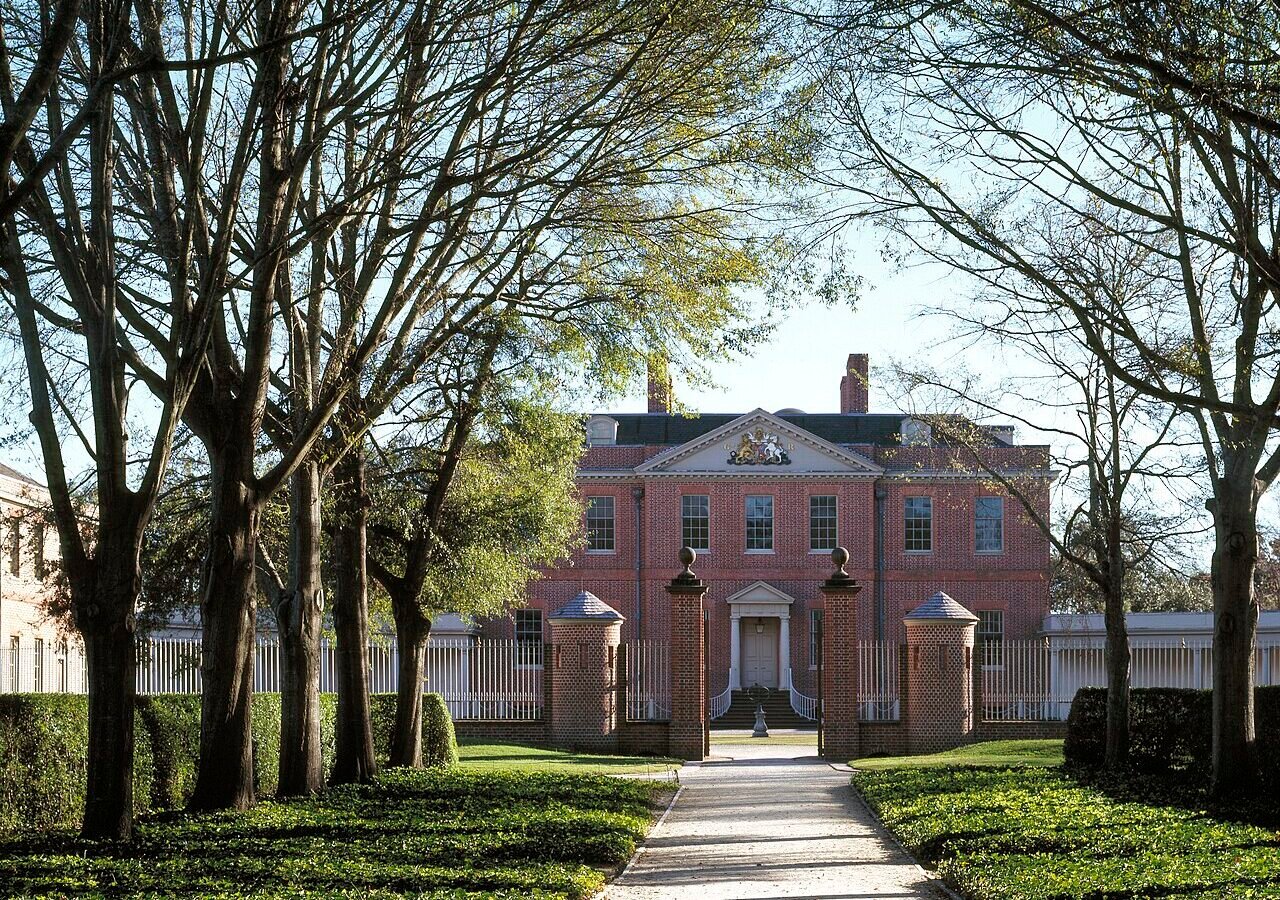
In December 1770, Governor William Tryon, his wife Margaret and their young daughter moved into a new house at the foot of George Street in New Bern, on the Trent River. It was built of brick, with a central block and two smaller buildings connected to it by curved colonnades. Few people in North Carolina had seen anything like it. Many of the colony's farmers, who were paying for it, never would.
Contemporaries called the house a palace, and the name stuck. It was the finest government building the colony ever produced, and it became a symbol of the gap between coastal officials and the people of the backcountry.
A colony without a capital
Colonial North Carolina had no fixed seat of government for most of its history. Governors and assemblies moved among towns such as Edenton, New Bern and Wilmington, and the colony's sprawling geography fed rivalries between the northeast and the Cape Fear region. Royal governors often rented houses or lived in their own homes.
New Bern had been founded in 1710 by Swiss and German settlers led by Baron Christoph von Graffenried, and it had grown into a busy river port. In the 1760s the assembly agreed to fund a permanent residence for the governor there, and New Bern emerged as the practical capital. Not everyone approved. Northern delegates objected to spending the colony's money so far to the south.
Building the palace
William Tryon, born in 1729, arrived in North Carolina in 1764 as lieutenant governor and became governor in 1765 after Arthur Dobbs died. He was an army officer with wealthy connections, and he cared about appearances. He brought an English architect, John Hawks, who drew up the design and supervised the work.
Construction began in 1767. Hawks designed a Georgian building with a symmetrical front and flanking service wings, a style that fit the formal image of royal authority. The building was meant to be both a home and a place of government, with space for the governor's council. By late 1770 it was finished.
The price of grandeur
The assembly first appropriated about £5,000 in the mid-1760s. Costs rose, and further appropriations followed. Most accounts put the total at roughly £15,000 or more in provincial money, though the exact figure depends on how the payments are counted. It was raised through taxes, including a poll tax that fell on every taxable person regardless of wealth.
That tax landed in the same years as the Regulator movement. Farmers in the Piedmont counties accused sheriffs and clerks of overcharging fees and abusing power, and they struggled with a shortage of hard money. Regulators did complain about the palace tax, but historians generally see their central grievances as local corruption and unequal treatment. The palace was a visible symbol of those complaints rather than their sole cause.
The conflict ended at the Battle of Alamance on May 16, 1771. Tryon led eastern militia against the Regulators and won. Several Regulators were later hanged. Tryon left North Carolina that summer to become governor of New York, only a few months after moving into the house.
Revolution, fire and loss
Tryon's successor, Josiah Martin, lived in the palace until the Revolution. In 1775 he abandoned it, fled to the Cape Fear coast and eventually boarded a British ship. After independence, state officials used the building, and George Washington attended a dance there during his Southern tour in April 1791.
The capital then moved inland. The state chose a site for Raleigh in the 1790s, and the palace lost its official role. In February 1798 a fire destroyed the main building. It reportedly started in the cellar, where hay was stored. Only the west wing, which had served as stables, survived. In the years that followed, New Bern built streets and houses across the former grounds.
Rebuilding from the plans
The rebuilding began with Maude Moore Latham, a Greensboro philanthropist who spent years collecting funds and antiques for a restoration. She worked with the state and with Gertrude Carraway, who led the effort for the Tryon Palace Commission. A key piece of evidence was Hawks's floor plan, which had survived, along with written descriptions.
In the early 1950s, architect William G. Perry, who had worked on Colonial Williamsburg, led archaeological excavations that found the foundations of the main building. Crews cleared the site of later houses and rerouted Pollock Street. The reconstruction opened to the public in April 1959. Only the stable wing is original, and the rest was rebuilt from plans and excavation.
Citation information
- Article title
- Tryon Palace: The Royal Governor’s Mansion and the Birth of a Colonial Capital
- Author
- admin
- Website name
- North Carolina Backstory
- URL
- https://northcarolinabackstory.com/tryon-palace-the-royal-governors-mansion-and-the-birth-of-a-colonial-capital/
- Original published date
- August 30, 2026
We strive for accuracy and fairness. If you see something that doesn’t look right, contact us.