Town Creek Mound: The Ceremonial Earthwork on the Pee Dee River
For centuries, people in the Pee Dee region raised and rebuilt a flat-topped earthen mound in Montgomery County, North Carolina, until the site fell quiet around 1400.
- When
- 1400
- Where
- Montgomery County, North Carolina
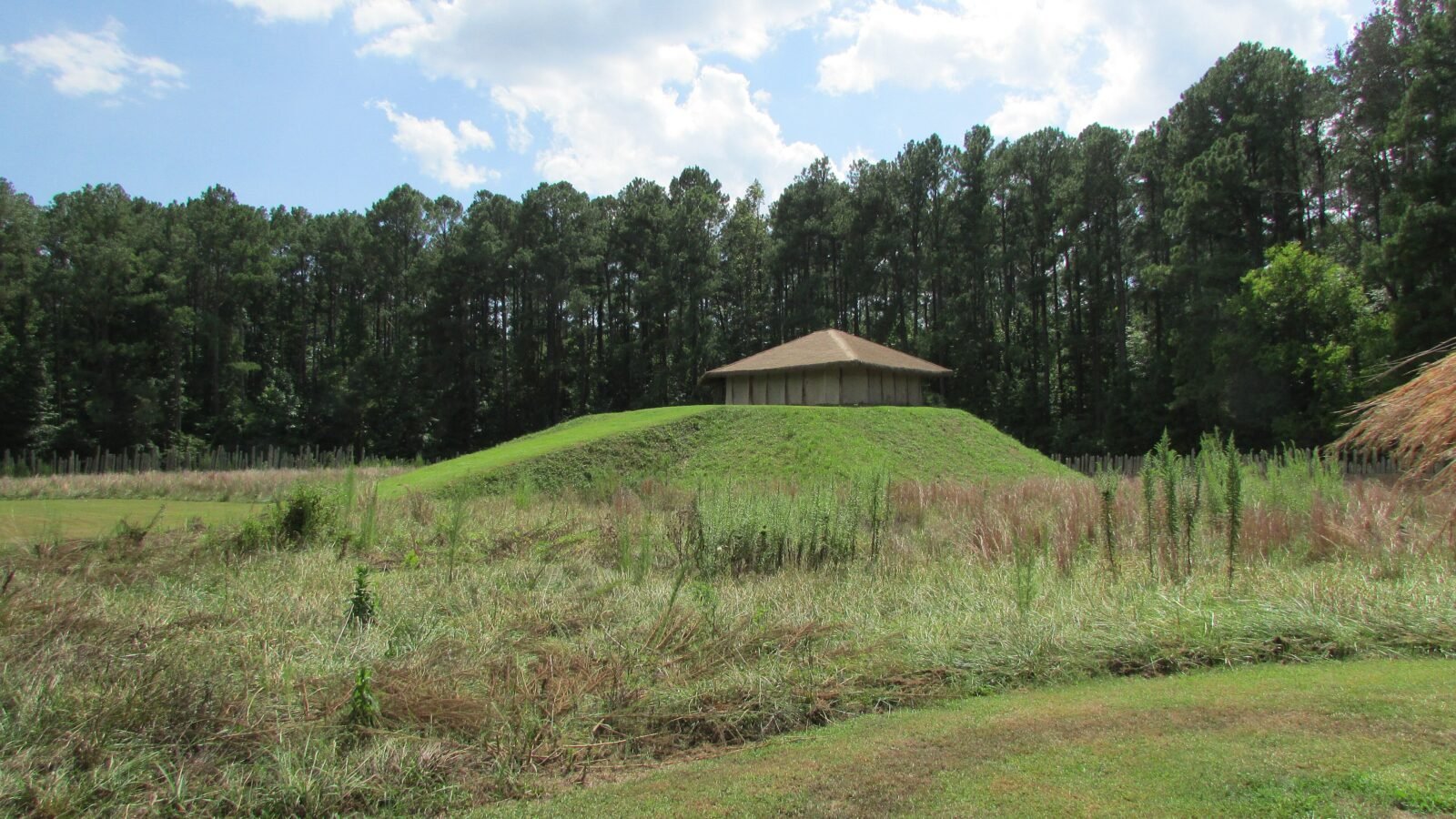
Walk the path up the side of Town Creek Mound and the ground begins to feel deliberate. The slope is smooth, the top is flat, and the outline of a long plaza stretches away toward the edge of the terrace. Nothing here was left to chance. People carried soil by hand to build this platform, then came back again and again to raise it higher and change its shape.
The mound stands in Montgomery County, North Carolina, near the town of Mount Gilead, on a rise above the Pee Dee River. It is now part of the Town Creek Indian Mound State Historic Site, and the mound and plaza are among the best-preserved examples of a ceremonial center in the Carolina Piedmont and coastal plain. Archaeologists have spent decades working out how the site was used, who was buried there, and how the community around it held together.
A mound built in stages
The mound was not a single project. Excavations in the 1930s, led by the North Carolina archaeologist Joffre Coe, showed that it had been built in several stages over a long period. Each stage added a new layer of earth, and at times the top was reshaped or enlarged. The builders used soil from nearby, and the layering preserves a record of repeated ceremonies on the summit.
The people who built the mound belonged to what archaeologists call the Pee Dee culture. Their settlement at Town Creek was active roughly between about 1000 and 1400, though researchers have debated the exact start and end of its main occupation. The site's connections to larger Mississippian-period societies to the west are visible in some of the pottery and artifacts, but its architecture and burial practices have their own local character.
Houses, a plaza and a wall
Around the mound, excavators found the remains of houses and other buildings, along with a plaza that was kept open and used for gatherings. Structures built on the summit of the mound appear to have been used for ceremonial and perhaps administrative purposes, rather than as ordinary homes. A reconstructed building now stands on the summit to give visitors a sense of what such a structure may have looked like, though the reconstruction is an interpretation, not a copy of a documented original.
A palisade, a wall of posts set into the ground, enclosed the central area of the site. Archaeologists found that the palisade was rebuilt more than once, which suggests that the community repeatedly decided that the enclosure mattered. The wall marked off sacred space from the surrounding settlement and controlled who could move through the central precinct.
The dead beneath the earthwork
Burials are central to understanding Town Creek. Excavators recovered human remains from within the mound and in the surrounding ground. Some remains appear to have been placed in a charnel house, a building where bodies were kept for a period before the bones were gathered and interred. This was a practice found at several Southeastern sites of the same era, and it points to a sustained relationship between the living and their ancestors.
Grave goods and ritual objects were recovered from the site as well. Among the best-known finds are carved stone pipes, some shaped as animals and birds, which show a high level of craft skill. Not every burial was equally rich, and archaeologists debate what the differences in grave goods say about rank, kinship or the role of particular individuals in ceremonies.
Who maintained the mound, and why it ended
The mound was maintained by a community, not a single ruler. Each rebuilding required labor, planning and agreement among the people who would use the space. The repeated changes to the summit and the plaza suggest an ongoing commitment that outlasted any one generation, even as the living community changed around it.
By about 1400, the mound was no longer being built up, and the main occupation at Town Creek had ended. The reasons are not fully settled. Researchers have pointed to shifts in population, changing patterns of settlement and political change across the region, but the evidence does not allow a single cause to be named with confidence. What the site does show is that a community kept one place sacred for centuries, and then stopped.
Citation information
- Article title
- Town Creek Mound: The Ceremonial Earthwork on the Pee Dee River
- Author
- admin
- Website name
- North Carolina Backstory
- URL
- https://northcarolinabackstory.com/town-creek-mound-the-ceremonial-earthwork-on-the-pee-dee-river/
- Original published date
- November 11, 2026
We strive for accuracy and fairness. If you see something that doesn’t look right, contact us.