Kings Mountain, 1780: The Overmountain Men Who Turned the Southern War
After a threat from a British major, frontier riflemen crossed the Blue Ridge and wiped out his Loyalist force in about an hour, reviving the Patriot cause in the Carolinas.
- When
- 1780
- Where
- Kings Mountain, South Carolina
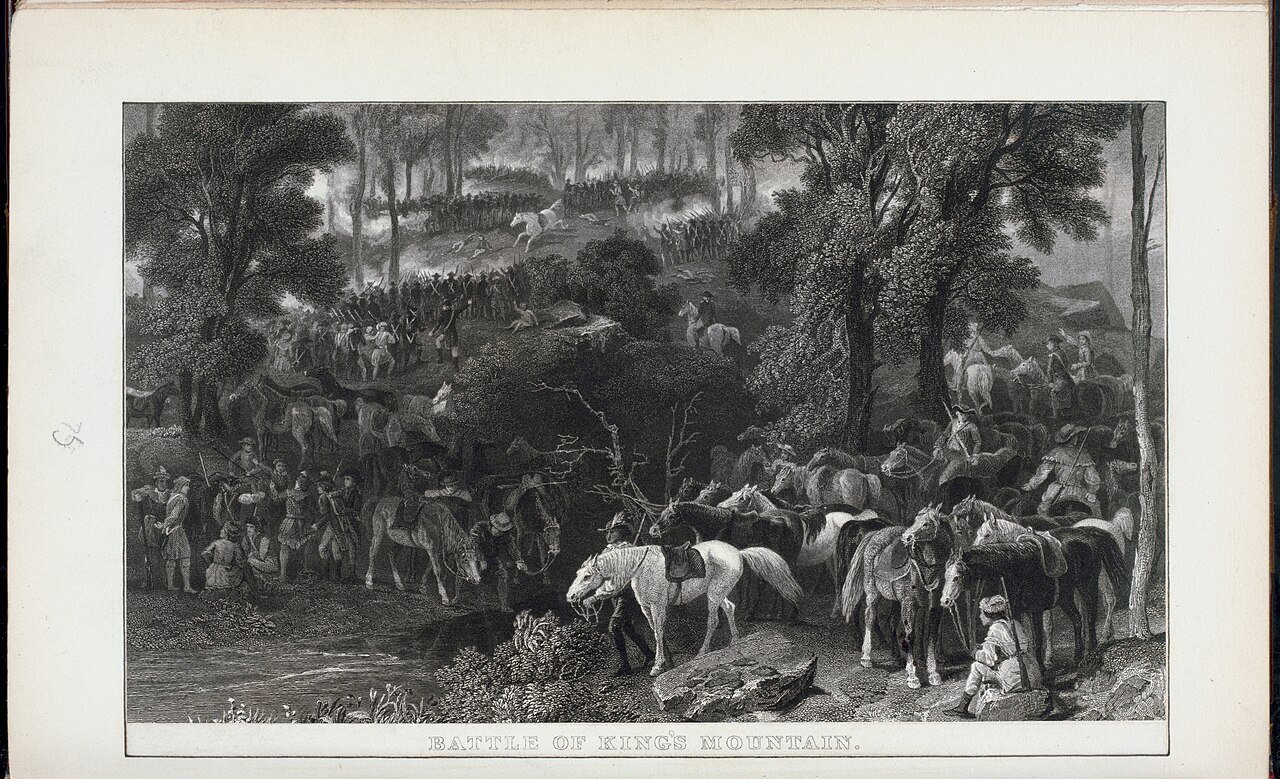
On the afternoon of October 7, 1780, about 900 mounted riflemen, soaked by a night and morning of rain, dismounted at the foot of a wooded ridge near the border of North and South Carolina. Above them, roughly a thousand Loyalist militiamen and their commander, Major Patrick Ferguson, held the rocky crown of Kings Mountain. Within about an hour, Ferguson would be dead and his command destroyed.
The men who did it came from settlements the British Army had never reached. Many lived west of the Blue Ridge, and many of the rest came from the foothills of western North Carolina. They had no regular army behind them, and they had been on the march for more than a week.
A war gone wrong for the Patriots
By the autumn of 1780 the Revolution in the South looked close to lost. Charleston fell to the British on May 12, with the capture of General Benjamin Lincoln's army. On August 16 Lord Cornwallis crushed Horatio Gates's army at Camden, South Carolina, and then moved north into North Carolina with Charlotte as his target.
Ferguson's job was to guard Cornwallis's western flank and to recruit and train Loyalist militia. A Scottish officer and the inventor of a breech-loading rifle that bore his name, he commanded men who were almost all American-born. The fighting in the backcountry was a civil war, with neighbors on both sides, and it was bitter.
The trouble with the mountain settlers began when Ferguson sent word across the Appalachians. According to the traditional account, a paroled Patriot prisoner carried his message: if the backcountry leaders did not stop resisting British arms, he would cross the mountains and lay waste to their country. The settlers had already had a taste of the fighting, since Isaac Shelby's men had clashed with Loyalists at Musgrove's Mill in August. Ferguson's threat gave them a reason to strike first.
The muster at Sycamore Shoals
The settlers gathered at Sycamore Shoals on the Watauga River, in what is now Elizabethton, Tennessee, around September 25 and 26. At the time the area was still part of North Carolina, and Tennessee would not be a state until 1796. Colonels Isaac Shelby and John Sevier brought several hundred men from the Holston and Watauga country, and Colonel William Campbell led a large contingent from Washington County, Virginia.
Local tradition says the Presbyterian minister Samuel Doak sent the men off with a blessing. The exact words attributed to him are traditional, and historians treat them with caution. The force left on September 26, crossed the Blue Ridge by way of the Roan Mountain highlands, and reportedly met snow on the high ground.
On September 30 they reached Quaker Meadows in Burke County, North Carolina, and joined other Carolina militia led by Colonels Charles and Joseph McDowell, Benjamin Cleveland and Joseph Winston. Some South Carolina fighters came in as well. Together they were a loose coalition of colonels with no single commander at first, and they chose Campbell to take overall direction.
The chase
Ferguson learned they were coming, partly from two deserters who slipped away from the Patriot column, and he began falling back toward Cornwallis at Charlotte. On the night of October 6 the Patriot leaders chose about 900 of their best-mounted men at Cowpens, South Carolina, to ride ahead. They pushed on through rain and darkness.
Ferguson stopped on Kings Mountain, a narrow, rocky ridge. It is a good place to defend against men who have to come uphill, and that appears to be why he chose it. A later story has him boasting that he was on the king's mountain and that God himself could not drive him from it. Historians cannot confirm the words.
An hour on the ridge
The Patriots arrived about three in the afternoon and split into columns that surrounded the ridge. They advanced from tree to tree, firing at the Loyalists silhouetted on the crest. Ferguson's men answered with bayonet charges that drove each column back downhill, but each time the attackers regrouped and returned from another side.
Slowly the circle tightened. Ferguson was shot from his horse and died on the field, reportedly hit by several bullets. Command passed to a subordinate, who tried to surrender. Some Patriots kept firing for a time, in part because they were not sure who was surrendering, and in part, by the accounts of survivors, out of anger at earlier atrocities.
Casualty figures vary by source. The commonly cited tallies are about 157 Loyalists killed and about 700 captured, against 28 Patriots killed, though some accounts differ. A week later, at Biggerstaff's farm in North Carolina, Patriot officers tried some of the prisoners for earlier crimes, and nine were hanged before the executions stopped.
Why it mattered
The victory removed Ferguson's force, a third of the Loyalist strength Cornwallis counted on in the Carolina interior. It also made the backcountry harder to hold, since Loyalists could no longer count on British support. Cornwallis abandoned his advance on Charlotte, which had been harassed by militia, and retreated into South Carolina on October 14.
Kings Mountain did not win the war. The year ended with the Patriot cause still in difficulty, but the momentum had shifted. Daniel Morgan's victory at Cowpens followed in January 1781 and the hard-fought battle at Guilford Courthouse in March, and Cornwallis turned north to Virginia and Yorktown.
The site is now Kings Mountain National Military Park, in South Carolina, established in 1931. The Overmountain Victory National Historic Trail, designated in 1980, follows the route the militiamen took from Sycamore Shoals to the battlefield.
Citation information
- Article title
- Kings Mountain, 1780: The Overmountain Men Who Turned the Southern War
- Author
- admin
- Website name
- North Carolina Backstory
- URL
- https://northcarolinabackstory.com/kings-mountain-1780-the-overmountain-men-who-turned-the-southern-war/
- Original published date
- March 22, 2026
We strive for accuracy and fairness. If you see something that doesn’t look right, contact us.