Camp Davis and the Anti-Aircraft Training Center at Holly Ridge, 1941 to 1946
In 1941 the Army turned a quiet crossroads in Onslow County into a gunnery school. For about five years, soldiers, prisoners and women pilots worked its ranges.
- When
- 1941
- Where
- Holly Ridge, Onslow County, North Carolina
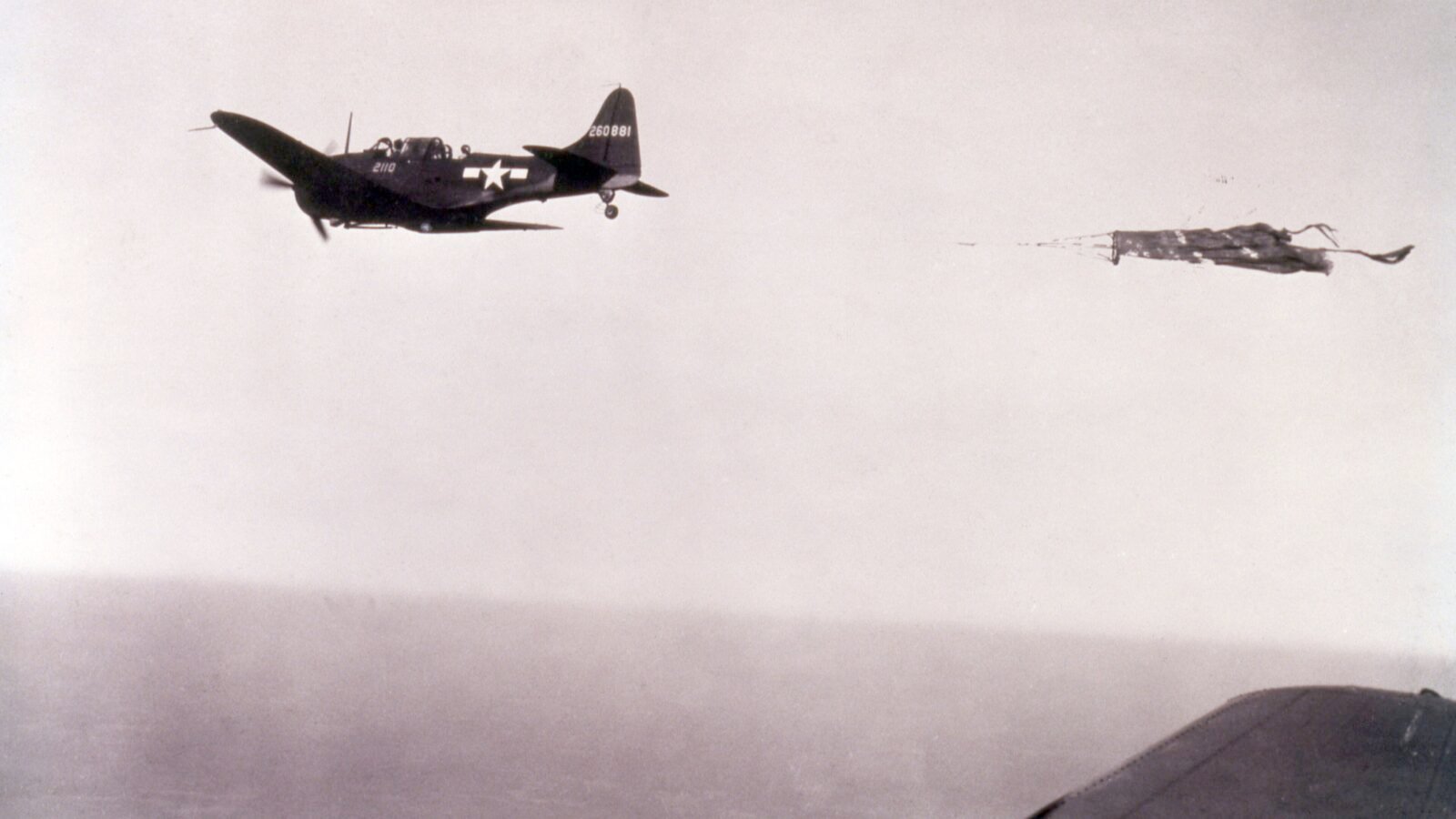
In the early 1940s, a gunner on the flat pine country of eastern North Carolina could look up and watch a tow plane drag a long cloth target sleeve across the sky. The sleeve was the point of the exercise. Each shell he fired was meant to hit it, and each shot was scored.
The place where those gunners learned their trade was called Camp Davis. It grew out of almost nothing at Holly Ridge, a small community in Onslow County, in a matter of months during 1941.
A village chosen for open ground
Before the war, Holly Ridge was a small settlement with a few houses, two stores and a train station. Its population was 28 in 1940, according to the state historical marker, and it grew rapidly once the Army arrived.
The Army needed a large tract of land for the new post. By the time construction was underway, the camp covered about 46,000 acres of the area near Holly Ridge. Construction began in December 1940, as the country prepared for a war it had not yet entered.
The post was named for Maj. Gen. Richmond P. Davis, a Statesville native, and it took the name Camp Davis. Its main job was to train antiaircraft artillery units, the crews who ran the guns, alongside seacoast defense and barrage balloon training.
Training an army in a hurry
The United States entered the war in December 1941, and antiaircraft units needed trained gun crews before they could be sent overseas.
At its height the post held roughly 20,000 officers and soldiers, and its courses included antiaircraft guns, seacoast guns, AA radar and barrage balloons. NCpedia gives a higher figure of more than 100,000 soldiers and civilian workers at the 1943 peak.
The camp's ranges were its defining feature. Crews practiced on towed targets at five remote coastal sites, and some pilots tested radio-controlled drones for gunnery training.
Segregated units and German prisoners
Like the rest of the wartime Army, Camp Davis operated under segregation. The base included white and black segregated units.
The post also held German prisoners of war, reportedly about 550 of them, beginning in March 1944. Sources say the prisoners were put to work, but the details of their labor are not confirmed here.
Accounts of individual prisoners' experiences at Camp Davis are limited, and this article does not name any of them.
Women pilots on the tow lines
The Women Airforce Service Pilots, known as WASP, flew a range of noncombat missions during the war, and towing targets for gunners was one of them. The program trained women to fly military aircraft so that male pilots could go overseas for combat duty, and WASP were stationed at Camp Davis in 1943 and 1944.
At Camp Davis, WASP pilots flew tow aircraft that pulled target sleeves for antiaircraft crews to fire at. The work let male pilots move to combat assignments and gave the gunners realistic targets. It also meant that women flew in the same airspace as live fire, a risk that the program's pilots accepted as part of the job.
The WASP program was not recognized as military service until nearly three decades after the war ended.
Closing the post and what came after
With the war's end, demand for antiaircraft training fell. Sources differ on when the post closed: the state marker program gives 1944, while Wikipedia gives 17 February 1946, and Army antiaircraft training had already moved to Fort Bliss in 1944.
The land did not sit idle. In June 1946 the Navy took over part of the former range, and under the name Operation Bumblebee it tested ramjet-powered missiles until 1948.
Citation information
- Article title
- Camp Davis and the Anti-Aircraft Training Center at Holly Ridge, 1941 to 1946
- Author
- Melissa Claire
- Website name
- North Carolina Backstory
- URL
- https://northcarolinabackstory.com/camp-davis-and-the-anti-aircraft-training-center-at-holly-ridge-1941-to-1946/
- Original published date
- November 19, 2026
We strive for accuracy and fairness. If you see something that doesn’t look right, contact us.