Marble Nash Taylor’s Proclamation From Hatteras, November 1861: A Unionist Governor on an Occupied Island
In November 1861, a Unionist convention on Union-held Hatteras Island set up a rival North Carolina government. Its governor, Marble Nash Taylor, then called on residents to return to the Union.
- When
- 1861
- Where
- Hatteras, Hyde County (now Dare County), North Carolina
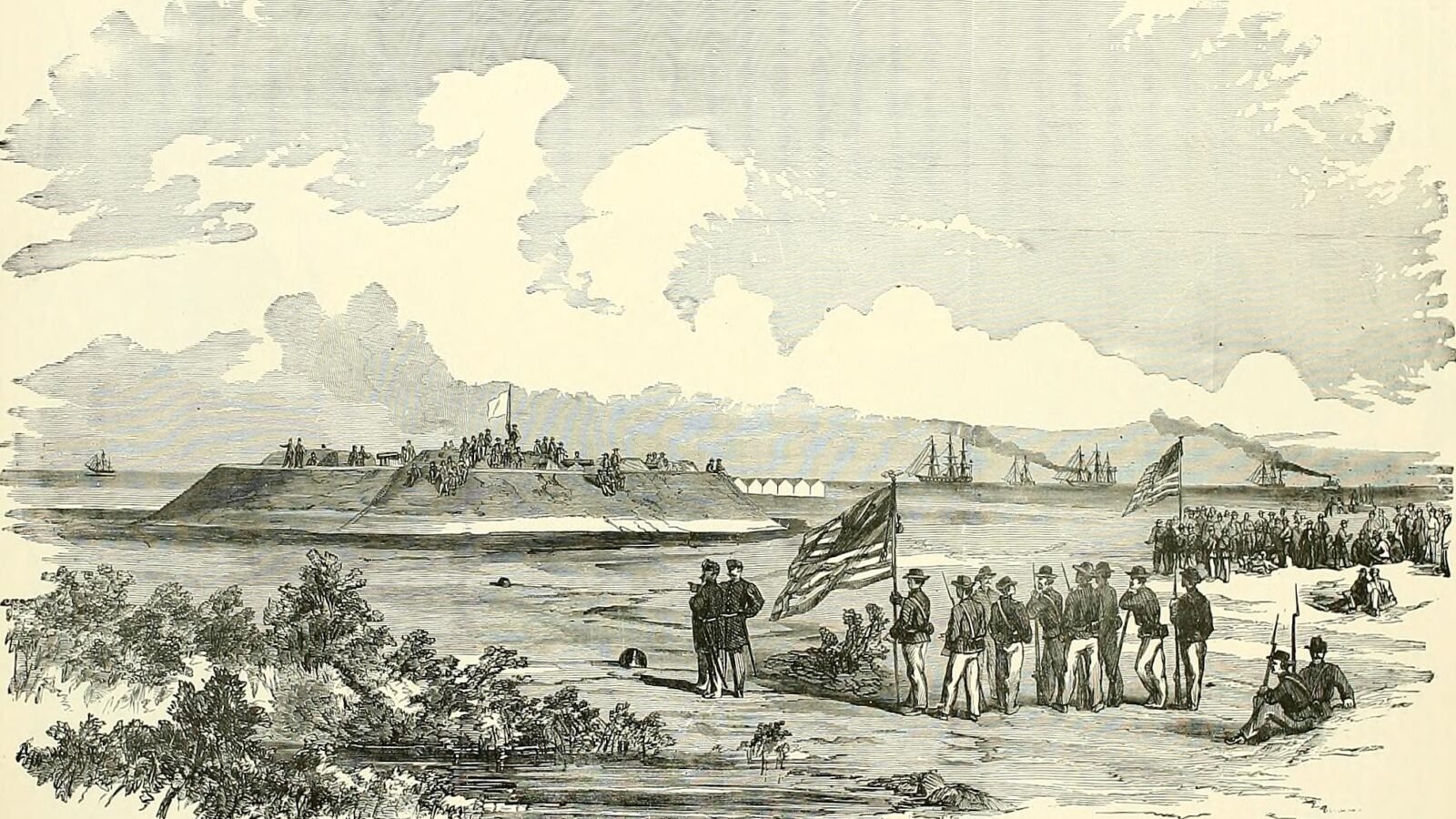
>In the fall of 1861, the sandy edge of North Carolina was one of the few places in the Confederacy where the United States flag flew. Hatteras Island, a thin chain of barrier sand between Pamlico Sound and the Atlantic, had been in Union hands since late August, when a naval and army force led by Benjamin F. Butler and Flag Officer Silas H. Stringham took the forts guarding Hatteras Inlet. On a small island far from Richmond and Raleigh, a group of Unionist men decided to act as though they were the government of the state.
Two days after they met, their appointed leader issued a proclamation. It was addressed to the people of North Carolina and declared that the men running the state under Confederate authority had no legitimate right to do so. The document was bold for a government that controlled only a few miles of sand. It was also, in the end, mostly words.
Burnside's foothold on the coast
Union forces captured Forts Hatteras and Clark on August 28 and 29, 1861, in an operation that opened a base on the North Carolina coast. The assault was led by Benjamin F. Butler and Flag Officer Silas H. Stringham. The island was originally part of Hyde County; it is now in Dare County.
The occupation brought a small community of Unionists into the open. In late August 1861, Hatteras citizens asked the federal commander to protect them, writing that they had not helped by their votes to take North Carolina out of the Union. Once federal troops were on the island, Unionists could organize without the immediate threat of Confederate reprisal.
North Carolina had seceded on May 20, 1861, and Confederate officials had taken control of state offices in Raleigh. Those officials had no real presence on Hatteras, but their claim to govern the state was the claim that Taylor's group would contest.
The Hatteras convention
A convention of Unionist delegates met at Hatteras on November 18, 1861. The convention claimed to represent forty-five counties, but John S. Carbone's 2001 study reports that only six or eight delegates appeared in person, and many claimed seats were supported by proxies. Its central step was to declare the existing state offices vacant and to set up a provisional government that would stand in for the Confederate one.
The convention chose Marble Nash Taylor as provisional governor. Taylor was a Virginia-born missionary and Methodist minister who had been assigned to the Hatteras Methodist Church in December 1860, and he was a staunch Unionist. The convention's ordinances declared the pre-secession state constitution in full force and the May 20, 1861 secession ordinance void.
The convention's authority was thin. Carbone reports that the hall was less than full, and the convention's claim to speak for forty-five counties depended largely on proxies. It had no direct means of enforcing its decisions beyond the protection of Union troops on the island.
The November 20 proclamation
Two days after the convention met, on November 20, 1861, Taylor issued his first proclamation. It called on North Carolinians to return to the Union and to abandon the Confederate government, which it described as usurpers holding power without a legitimate mandate. It declared the secession ordinance void and said the state's constitution remained in force.
The proclamation was issued from Union-held Hatteras, but its reach beyond the island's small population was limited. Confederate newspapers did respond: the Richmond Dispatch ran a hostile biographical sketch of Taylor in December 1861.
The Hatteras leaders also addressed Washington. In a November 18 letter to President Lincoln, they announced the provisional government and claimed the backing of loyal citizens, but Lincoln was not impressed with the effort.
The Foster election and the limits of a shadow government
The Hatteras government moved next to elections. Voters on Hatteras Island, the only area of the state then under Union control, were invited to choose a representative to the United States Congress. The contest that followed is usually called the Foster election after the candidate who won. For the Hatteras government, the vote was evidence that North Carolina's loyal citizens still wanted a seat in Washington.
The effort had little practical effect. Voting at four island precincts on November 28, 1861 reportedly produced 268 votes, all for Foster. On December 18, 1861, the House Committee on Elections, and then the House, declined to seat him, and the House rejected his claim again on June 16, 1862.
The Hatteras government did not last. Foster left Hatteras in March or early April 1862, and on May 28, 1862, Lincoln's appointment of Edward Stanly as military governor effectively ended the Hatteras claims.
Why Confederate North Carolina dismissed it
Confederate North Carolina dismissed the Hatteras effort as the work of traitors. Richmond newspapers mocked Taylor's proclamation and his supporters, describing the proclamation as a call to renew an alliance with the United States.
The convention's appeal to loyalty ran against the Confederate war effort. The sources reviewed here do not record any substantial response from inland North Carolinians to the proclamation.
A Hatteras monument calls the convention America's first attempt at Civil War reunification, a description that reflects the convention's symbolic significance. Taylor's proclamation shows how the Union tried to build loyal governments in occupied Southern territory, and how those efforts depended on federal troops on the island.
Citation information
- Article title
- Marble Nash Taylor’s Proclamation From Hatteras, November 1861: A Unionist Governor on an Occupied Island
- Author
- Samantha Brown
- Website name
- North Carolina Backstory
- URL
- https://northcarolinabackstory.com/marble-nash-taylors-proclamation-from-hatteras-november-1861-a-unionist-governor-on-an-occupied-island/
- Original published date
- November 20, 2026
We strive for accuracy and fairness. If you see something that doesn’t look right, contact us.