Ocracoke Lighthouse, 1823: Rebuilding an Inlet Light After the Channel Moved
A tower built for one channel became useless when the water moved. The 1823 brick light on Ocracoke Island was built to replace it, and it has outlasted the war that saw its lens removed.
- When
- 1823
- Where
- Ocracoke, Hyde County, NC
On a dark night in the early 1800s, a pilot steering a vessel toward Ocracoke Inlet needed one thing above all: a light that showed exactly where the safe water lay. The inlet connects the Atlantic to Pamlico Sound, and the sand that shapes it never stays put. A light that marked the wrong spot could put a ship on a shoal within sight of land.
The lighthouse that stands on Ocracoke Island today, a brick tower completed in 1823, was a replacement. It was built because the first light at the inlet had lost its purpose when the channel moved. Its history shows how an inlet light differed from the lights along the open coast, and why the Ocracoke tower was rebuilt where it is.
Why an inlet needed its own light
The lights most people picture on the Outer Banks, such as those at Cape Hatteras and Bodie Island, stood along the open ocean shore. Their job was to warn sailors offshore that they were nearing a dangerous coastline. Ocracoke's light is different: it is an inlet light rather than a coastal light.
An inlet light had a narrower task. It guided a ship through a gap in the barrier islands, across shifting bars and into the sound behind them. The light had to sit close to the channel itself, and its position had to match the channel's location. When the water moved, the light's usefulness moved with it, and a tower that was well placed one decade could be misplaced the next.
Ocracoke Inlet was the most important trade route in North Carolina during the early republic, and its channel shifted constantly. That instability shaped every light built to mark it.
A tower on Shell Castle Island
The first light at Ocracoke Inlet was a wooden, pyramid-shaped tower on Shell Castle Island, a small island near the inlet. Its completion is usually dated to 1798, though some sources give 1803. It stood where the channel ran at the time, and for a short while it served mariners.
Then the channel shifted. Sand built up in the old passage and the water that ships needed moved to another route. A light on Shell Castle Island no longer marked the way through, and mariners had to rely on local pilots who knew where the new water ran.
The problem was position, not the tower's construction: the light no longer stood where ships ran. Congress first tried a light vessel near the inlet, which also proved unsatisfactory. In May 1822 it appropriated $20,000 for a lighthouse on Ocracoke Island, a project placed under the Treasury Department, which then oversaw lighthouses.
Brick on Ocracoke Island, 1823
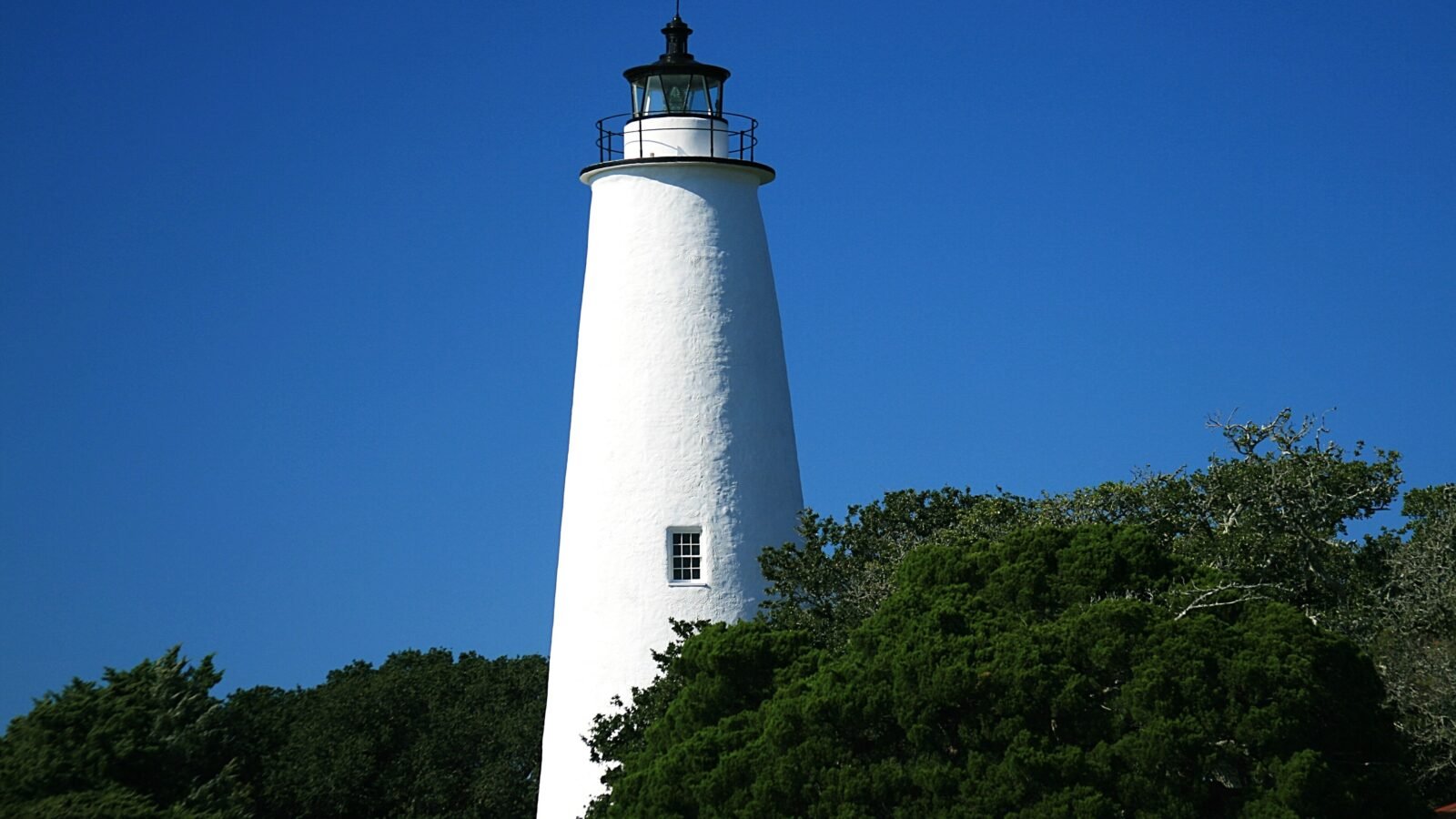
The new tower was completed in 1823 on Ocracoke Island. It was built of brick, finished with a whitewash of lime, salt, whiting, rice, glue and boiling water, and it stands about 65 feet tall, with its light roughly 75 feet above sea level.
The tower's site was a two-acre plot near Silver Lake Harbor, bought from Jacob Gaskill for $50 in December 1822. Placing the light on Ocracoke Island, away from Shell Castle, answered the problem that had made the older tower useless. That made the light a response to a specific problem, not a general improvement to the coast.
The National Park Service describes the Ocracoke tower as the oldest functioning lighthouse in North Carolina, and the second oldest working lighthouse in the nation. Bald Head Island's light is older but is no longer an active aid to navigation.
Lens, lightning and the Civil War
Like many American lights of its era, Ocracoke's tower was fitted with a fourth-order Fresnel lens in 1854, a glass optic made of concentric prisms that gathered a lamp's light into a far stronger beam. The lens greatly intensified the light. It also made the optic itself a valuable piece of equipment.
The tower has also faced natural threats. Lightning destroyed the earlier Shell Castle tower and its keeper's house in 1818. The Ocracoke tower was given lightning protection during a 2009 restoration.
The Civil War brought a different threat. In 1861 or 1862 (sources differ), Confederate forces removed the tower's lens to keep Union troops from using the light to navigate the channel as federal forces moved along the Outer Banks. Union forces reinstalled the lens in 1863 or 1864 (sources differ), and the light was out of service for a period during the war. The story of the lens shows how coastal aids to navigation became military concerns during the conflict.
A light that outlasted its first channel
The 1823 tower outlived the channel that justified it. Ocracoke Inlet has kept shifting, and the National Park Service says the light is still needed because of the constantly changing inlet and its shoals. The brick tower on Ocracoke Island remains, a reminder that an inlet light was only as good as its position.
The Shell Castle tower of 1798 has no comparable survival. Lightning destroyed it and its keeper's house in 1818, after the channel had already moved away and made it obsolete. The surviving tower carries that history: it was built because a light had to be moved to where ships actually sailed.
Citation information
- Article title
- Ocracoke Lighthouse, 1823: Rebuilding an Inlet Light After the Channel Moved
- Author
- Samantha Brown
- Website name
- North Carolina Backstory
- URL
- https://northcarolinabackstory.com/ocracoke-lighthouse-1823-rebuilding-an-inlet-light-after-the-channel-moved/
- Original published date
- November 20, 2026
We strive for accuracy and fairness. If you see something that doesn’t look right, contact us.