Camp Bragg, 1918: The Artillery Training Camp That Became Fort Bragg
In 1918 the Army chose a sandhills tract near Fayetteville to train artillerymen. The war ended, the camp nearly closed, and a post commander's fight kept it open.
- When
- 1918
- Where
- Fayetteville, Cumberland County, North Carolina
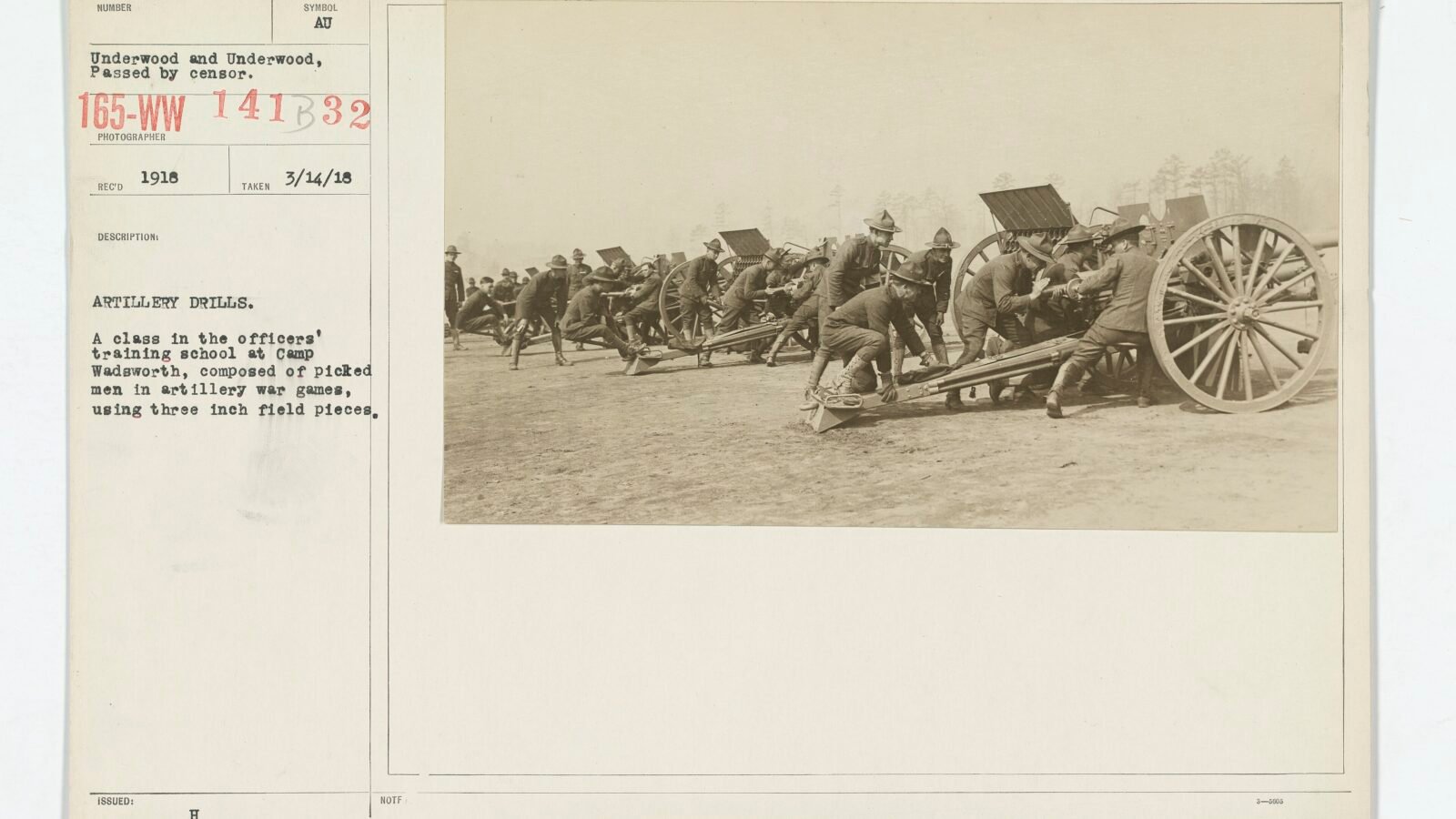
In the late summer of 1918, the Army chose a stretch of pine barrens just outside Fayetteville, North Carolina, as the site of a new artillery training camp. The Army was building a place to teach gunners how to fire the heavy artillery that American units needed for the fighting in France.
The war ended before the new camp had a chance to prove itself. The Armistice of November 11, 1918, left the Army with a fast-shrinking wartime force and a long list of camps to close. The site that would become Fort Bragg came close to being one of them.
Why the Army needed a new artillery range
Before the United States entered the First World War in April 1917, the regular Army was small, even by today's standards. Firing live shells requires a large impact area, room to maneuver guns, horses and trucks, and enough distance from towns to be safe. Existing posts could not offer all of that at the scale the wartime expansion demanded.
As the draft brought in men and the Army built cantonments across the country, the artillery branch needed its own training ground. An initial search in Maryland and Virginia came up empty, so the Army widened the hunt. Col. Edward P. King and geologist T. Wayland Vaughn searched for a site with adequate water, suitable soil, nearby rail transportation and a climate suitable for year-round training. The search was practical, not sentimental.
A sandhills tract outside Fayetteville
Col. Edward P. King, working on the search with geologist T. Wayland Vaughn, recommended a tract in the sandhills of Cumberland County, close to Fayetteville. The sandhills were chosen for their climate, level topography, access to rail lines, and because the land was not productive farmland. Fayetteville had rail connections, so men and materiel could be moved in and out.
The Army named the new installation Camp Bragg, after Braxton Bragg, a Confederate general and North Carolina native. The camp was officially established on September 4, 1918, and construction began in the weeks that followed. Units and equipment from Camp McClellan, Alabama, including artillery forces, a balloon company and an air squadron, arrived in February 1919, after the fighting had stopped.
The Armistice and the threat of closure
After the Armistice, the War Department began demobilizing its wartime forces and reviewing which of its facilities to keep. In August 1921 the War Department ordered Camp Bragg abandoned as the country demobilized, and the camp's future was in doubt.
Closing the site would have saved money at a time of budget cuts. Keeping it required an argument that the postwar Army needed a valuable, permanent artillery training post. That argument had to be made to officers who were cutting budgets.
A commander who kept the post open
The camp survived largely because of the officer who commanded it, Brig. Gen. Albert J. Bowley, who took command in July 1921. He argued that the camp was too valuable as a training post to abandon, and he lobbied politicians to keep it open. After an inspection by Secretary of War John W. Weeks, the abandonment order was rescinded in September 1921.
In 1922 the War Department designated Camp Bragg a permanent post, and on September 30, 1922, it was renamed Fort Bragg. The change turned a wartime camp into a garrison with a future. Field artillery remained its main mission through the 1920s and 1930s, and the post grew slowly as the Army's budgets allowed.
From artillery post to airborne home
The next major change came with the Second World War. In 1942 the Army established its airborne command at Fort Bragg, and Fort Bragg became the center of American airborne soldiering. The 82nd Airborne Division was assigned to the post in 1946, after returning from Europe.
The artillery that began the story in 1918 did not disappear, but it was no longer the post's defining identity. A camp that was nearly abandoned after the Armistice became one of the best-known military installations in the United States.
A short note on the name
The post's name honored Braxton Bragg, and it stood for more than a century. In 2023 the Army renamed the post Fort Liberty, and in 2025 it restored the Bragg name, this time linked to a different namesake, a World War II paratrooper named Roland Bragg. The naming debates are a separate story, and this article covers only the 1918 origins and the post's history up to the airborne era.
Citation information
- Article title
- Camp Bragg, 1918: The Artillery Training Camp That Became Fort Bragg
- Author
- Melissa Claire
- Website name
- North Carolina Backstory
- URL
- https://northcarolinabackstory.com/camp-bragg-1918-the-artillery-training-camp-that-became-fort-bragg/
- Original published date
- November 23, 2026
We strive for accuracy and fairness. If you see something that doesn’t look right, contact us.