Torpedo Junction: German U-boats off the North Carolina Coast, 1942
In early 1942, U-boats hunted tankers against the glow of American towns off Cape Hatteras. The toll was heavy before convoys and a British trawler's loss changed the war.
- When
- 1942
- Where
- Outer Banks, North Carolina
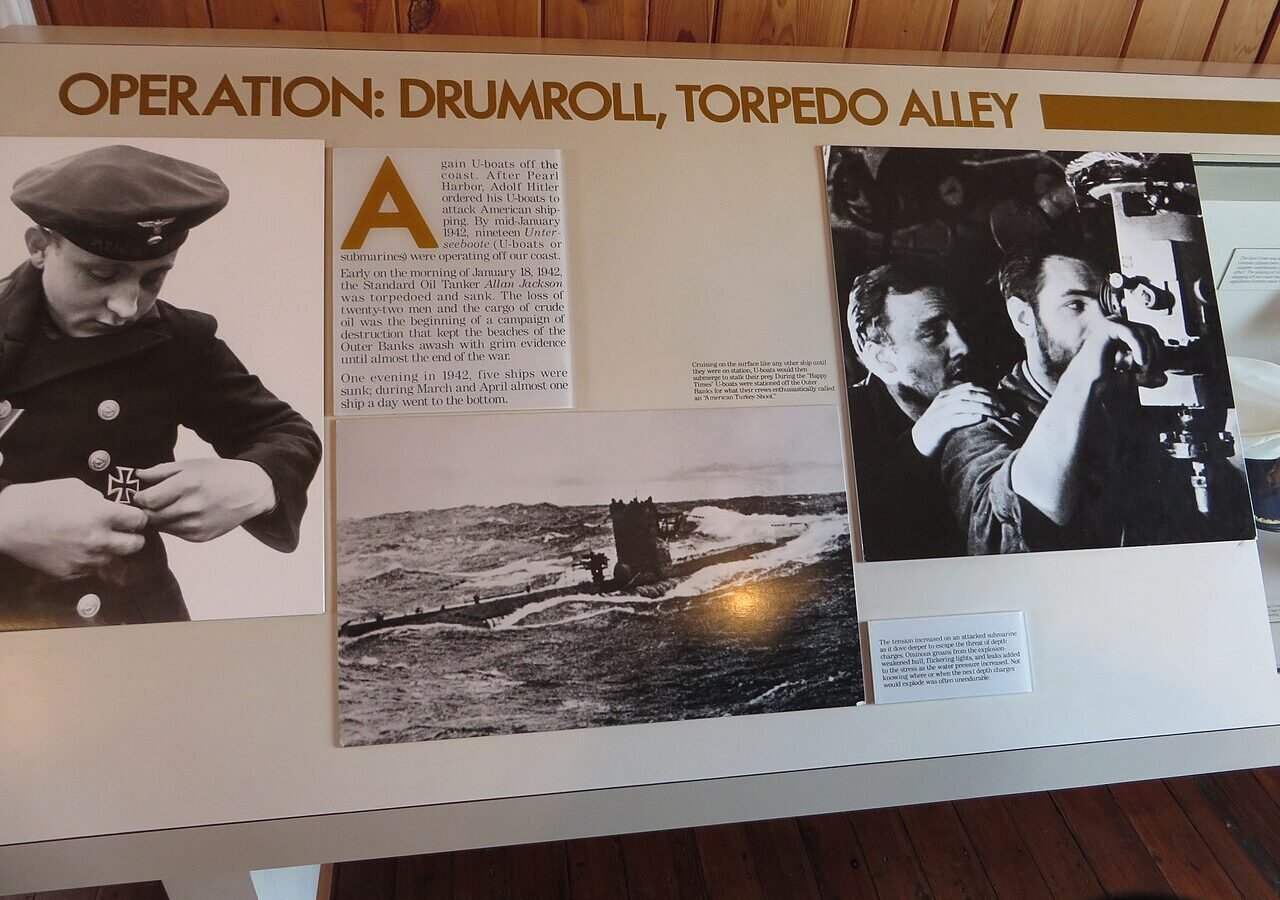
On the night of January 18, 1942, Kapitänleutnant Reinhard Hardegen brought U-123 up toward the North Carolina coast and found a navigator's dream. Ships moved along the American seaboard with their running lights on. Towns on shore were lit as in peacetime. Against that glow, merchant ships stood out as clear targets for a submarine that had just crossed the Atlantic.
Over the next six months the waters off Cape Hatteras became one of the deadliest places in the Atlantic war. Sailors called it Torpedo Junction. Residents of the Outer Banks watched the war arrive in flames, oil slicks and bodies on the beach.
Why Hatteras
Cape Hatteras sticks far out into the Atlantic, and Diamond Shoals extend beyond it. Coastal shipping from the Gulf of Mexico, Texas refineries and Caribbean ports had to squeeze past it on the way north. Ships there were funneled into a narrow lane, and the Gulf Stream passes close by. The same geography had wrecked sailing ships for centuries and earned the coast its name, the Graveyard of the Atlantic.
Germany declared war on the United States on December 11, 1941. Admiral Karl Dönitz quickly sent a handful of long-range Type IX boats to American waters in an operation the Germans called Paukenschlag, usually translated as Drumbeat. Hardegen's U-123 was one of them. Smaller boats followed in the spring, supplied by large supply submarines.
Lights on, no convoys
The United States was badly unprepared for anti-submarine warfare on its own coast. The Navy's Eastern Sea Frontier, under Admiral Adolphus Andrews, had few escort vessels. Britain had used convoys since 1939, but American commanders were slow to organize them along the coast. Historians generally attribute this mainly to a shortage of escorts rather than to simple stubbornness, though the Navy's slow response has long been criticized.
Coastal communities also resisted blackouts, partly because tourism and business depended on lights. Dimming the shoreline was recommended and then ordered in stages, with a dimout in force in many areas by about May 1942. Until then, U-boat commanders could pick out ships silhouetted against shore lights. Allied code-breaking also suffered, because the Germans introduced a new Enigma setting for their Atlantic boats in February 1942 that British and American analysts could not read for many months.
The results were severe. Dozens of ships were sunk off North Carolina in the first half of the year, many of them oil tankers. Merchant seamen died by the hundreds, and burning ships were sometimes visible from shore. Exact totals vary by source and by how the area is defined.
The Bedfordshire
One of the best-remembered losses was not a merchant ship. HMT Bedfordshire was a British armed trawler, one of about two dozen loaned by the Royal Navy to the U.S. Navy in 1942 to help patrol the coast. She worked out of Morehead City and Ocracoke. On May 11, 1942, U-558 sank her off Ocracoke, and all 37 men aboard were lost.
Four bodies later washed ashore. Two were identified as Sub-Lieutenant Thomas Cunningham and Telegraphist Stanley Craig, and two were never named. Ocracoke residents buried them in a small plot that is now the British Cemetery, where the Royal Navy and the village still hold a remembrance ceremony each May. The wreck lies off Cape Lookout, and divers visit it.
Turning the tide
The U.S. response was improvised and gradual. The Army Air Forces and the Civil Air Patrol flew coastal patrols, destroyers and Coast Guard cutters were pulled in, and the British trawlers helped. In mid-May 1942 the Navy began running escorted daytime convoys between Hampton Roads and Key West, with ships anchoring in protected harbors overnight, including Cape Lookout Bight. An interlocking convoy system covering the coast followed over the summer.
The U-boats also began to pay a price. USS Roper sank U-85 off the Outer Banks on April 14, 1942. The Coast Guard cutter Icarus sank U-352 off Cape Lookout on May 9, and the survivors became among the first German prisoners taken by U.S. forces in the war. On July 7, U-701 was sunk by an Army aircraft off Hatteras.
By July, sinkings off the Carolinas had fallen sharply, and Dönitz shifted his boats to the Caribbean and Gulf, where defenses were still weaker. Overall losses in the Atlantic stayed high through 1942, so the coast was not the end of the campaign.
Why it mattered
The Hatteras losses cost the Allies many ships and cargoes, including oil needed in Britain and for the war effort. They also forced the United States to learn convoy escort, air patrol and coordination quickly. The lessons were expensive, and the Outer Banks, with its graves, wrecks and memorials, still carries evidence of that cost.
Citation information
- Article title
- Torpedo Junction: German U-boats off the North Carolina Coast, 1942
- Author
- admin
- Website name
- North Carolina Backstory
- URL
- https://northcarolinabackstory.com/torpedo-junction-german-u-boats-off-the-north-carolina-coast-1942/
- Original published date
- May 14, 2026
We strive for accuracy and fairness. If you see something that doesn’t look right, contact us.