Black Mountain College: The Tiny North Carolina School That Remade American Art
For 24 years a small, broke college in the Blue Ridge hosted the Alberses, Cage, Cunningham, Rauschenberg and Fuller, and changed American art.
- When
- 1933
- Where
- Black Mountain, North Carolina
In the summer of 1948, Buckminster Fuller and a crew of students stood on the grounds of Black Mountain College in western North Carolina and tried to raise a dome. It was made of thin metal strips, the sort used for venetian blinds, and it was meant to show that a light, self-supporting structure could span a large space. It would not stand up. Students later called it the Supine Dome.
The failure did not matter much. Fuller returned the next summer and built a dome that held, and the episode became one of many at a school where experiments counted for more than outcomes. Black Mountain College never had more than about a hundred students at a time, and it was always short of money. It still became one of the most influential schools in the history of American art.
A college started by a dismissed professor
Black Mountain College grew out of a quarrel. John Andrew Rice, a classics professor, was dismissed from Rollins College in Florida in 1933 after clashing with its administration. He and a few colleagues, including Theodore Dreier and Ralph Lounsbury, decided to start a school of their own.
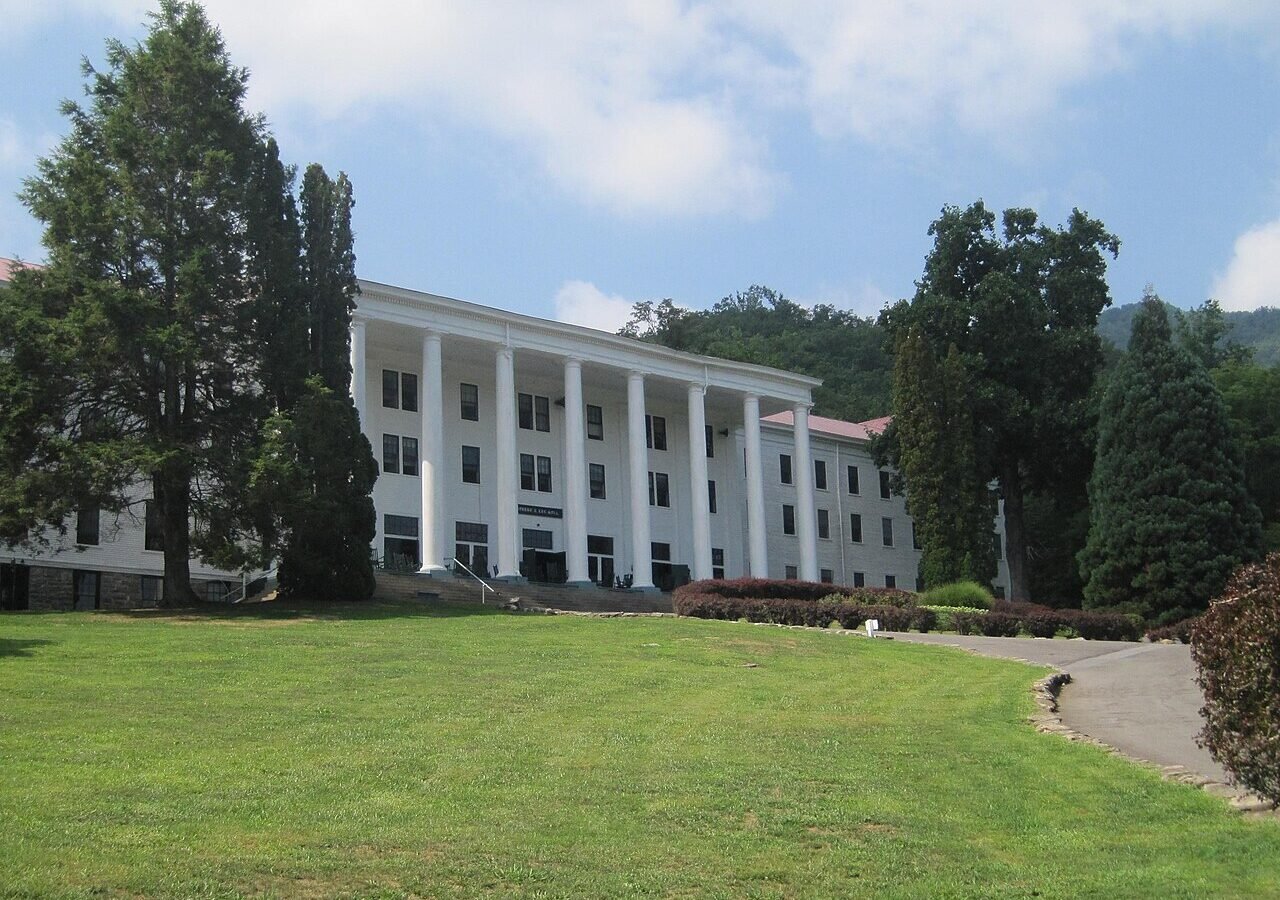
They opened in the autumn of 1933 in buildings borrowed from the Blue Ridge Assembly, a Protestant summer conference center near the town of Black Mountain. The college had no conventional board of trustees, and the faculty ran it. Rice and his colleagues believed that education should shape whole people and that the arts belonged at the center of the curriculum, not at its edge. Students took part in the daily work of the community, and in the early years that included farm and construction work.
In 1937 the college leased a property at Lake Eden, a few miles away, with an option to buy it. By 1941 the community had moved there and was building its own campus. Rice left in 1940 after disputes within the faculty, and the college continued without him.
The Bauhaus comes to the Blue Ridge
The most important early hire was Josef Albers. A former teacher at the Bauhaus, the German design school, Albers lost his position when the school closed in 1933 under Nazi pressure. The architect Philip Johnson helped connect him with Rice, and Albers arrived in North Carolina that fall with his wife, the textile artist Anni Albers. Neither spoke much English at first.
Josef Albers led the art program until 1949. His teaching focused on seeing: how colors affect one another, how materials behave, how a simple exercise can change the way a student looks at the world. Anni Albers taught weaving and later became one of the most respected textile artists of the century.
The Alberses also drew other refugees from Europe to the college. As a result, a school in a small Southern town became an unlikely meeting point between European modernism and American students.
The summers that changed things
Black Mountain's summer sessions brought in visitors who might not have come for a full academic year. In 1948 the roster included Fuller, the composer John Cage, the dancer Merce Cunningham, and the painters Willem and Elaine de Kooning. That summer Cage and Cunningham joined a production of Erik Satie's play The Ruse of Medusa, in which Fuller also performed.
Robert Rauschenberg studied at the college in 1948 and 1949, partly under Albers, and returned in 1951 and 1952. Albers's demanding approach made a strong impression on him, though Rauschenberg's work moved in a very different direction. His all-white canvases of 1951 are often linked to Cage's silent composition 4'33", which was first performed in 1952 at Woodstock, New York. Cage himself later credited the paintings as an influence.
Other students and teachers from these years include the artists Ruth Asawa, Cy Twombly and Kenneth Noland, and the poets Charles Olson and Robert Creeley. Olson became the college's last rector, serving in the 1950s, and his teaching helped make the school a center of experimental poetry. Cunningham's dance company, one of the most important in modern dance, was formed during the summer of 1953 at Black Mountain.
A performance, a legend and a quiet end
In August 1952 Cage, Cunningham, Rauschenberg, Olson, the poet M. C. Richards and the pianist David Tudor took part in an untitled event in the college dining hall. Audience members sat in sections around the room while performers worked at different times and in different ways. Some accounts describe it as the first Happening, a term not coined until later by Allan Kaprow, and historians still argue over exactly what took place, because the event was not documented in a single reliable record and participants remembered it differently.
The college did not last. It was always poor, depended on tuition and gifts, and lost students and stability after Albers and others left. It closed in 1957, after 24 years. Its roughly 1,200 students over those years are a small number next to the school's reputation.
What lasted was a way of working. Black Mountain showed that artists in different fields could learn from one another in the same room, and many who passed through carried that idea into New York galleries, concert halls and dance studios. The campus buildings at Lake Eden still stand, now used by a summer camp, and the Black Mountain College Museum + Arts Center in Asheville keeps its story.
Citation information
- Article title
- Black Mountain College: The Tiny North Carolina School That Remade American Art
- Author
- admin
- Website name
- North Carolina Backstory
- URL
- https://northcarolinabackstory.com/black-mountain-college-the-tiny-north-carolina-school-that-remade-american-art/
- Original published date
- April 25, 2026
We strive for accuracy and fairness. If you see something that doesn’t look right, contact us.