Fort Macon Falls: Burnside’s Siege of the Bogue Banks Fort, April 1862
In April 1862, Union artillery breached the walls of an 1834 brick fort at Beaufort Inlet and knocked many of its guns out of action, and its surrender gave the Union a foothold on the North Carolina coast.
- When
- 1862
- Where
- Atlantic Beach, Carteret County, North Carolina
On a spring morning in late April 1862, the men inside Fort Macon could hear Union guns being hauled into position on the sand dunes outside the walls. The fort was a three-tier brick work on the eastern tip of Bogue Banks, built to guard the channel into Beaufort Inlet. Now it was about to be the target of a deliberate siege.
The fort's fall was one of the first major Union successes on the North Carolina coast in the Civil War. It also showed how much the old masonry forts built before the war had been overtaken by rifled artillery. The result was a Union base that stayed in use until the end of the war.
A fort built for a coast that never came
Fort Macon was built between 1826 and 1834 as part of the national coastal defense program. Its brick walls were pierced for guns in tiers, and the masonry was a casemated fort.
In April 1861, after the Civil War had begun but before North Carolina seceded in May, local militia from Beaufort seized the fort for the state. The Confederate commander at the fort at the time of the siege was Col. Moses J. White, who led a garrison of roughly 400 men.
In late March 1862, Union forces occupied Morehead City and Beaufort without resistance. That left Fort Macon isolated, but it still guarded the channel into Beaufort Inlet.
The Union lands on Bogue Banks
In early 1862, Union forces under Ambrose E. Burnside moved along the North Carolina coast after their earlier operations at Hatteras Inlet and Roanoke Island. After taking New Bern in mid-March, Burnside turned to Beaufort and the inlet guarded by Fort Macon.
Union troops landed on Bogue Banks in late March 1862, several miles from the fort, and began to cut off its land approaches. After the garrison refused surrender demands on March 23 and again on April 23, Burnside's forces began siege operations.
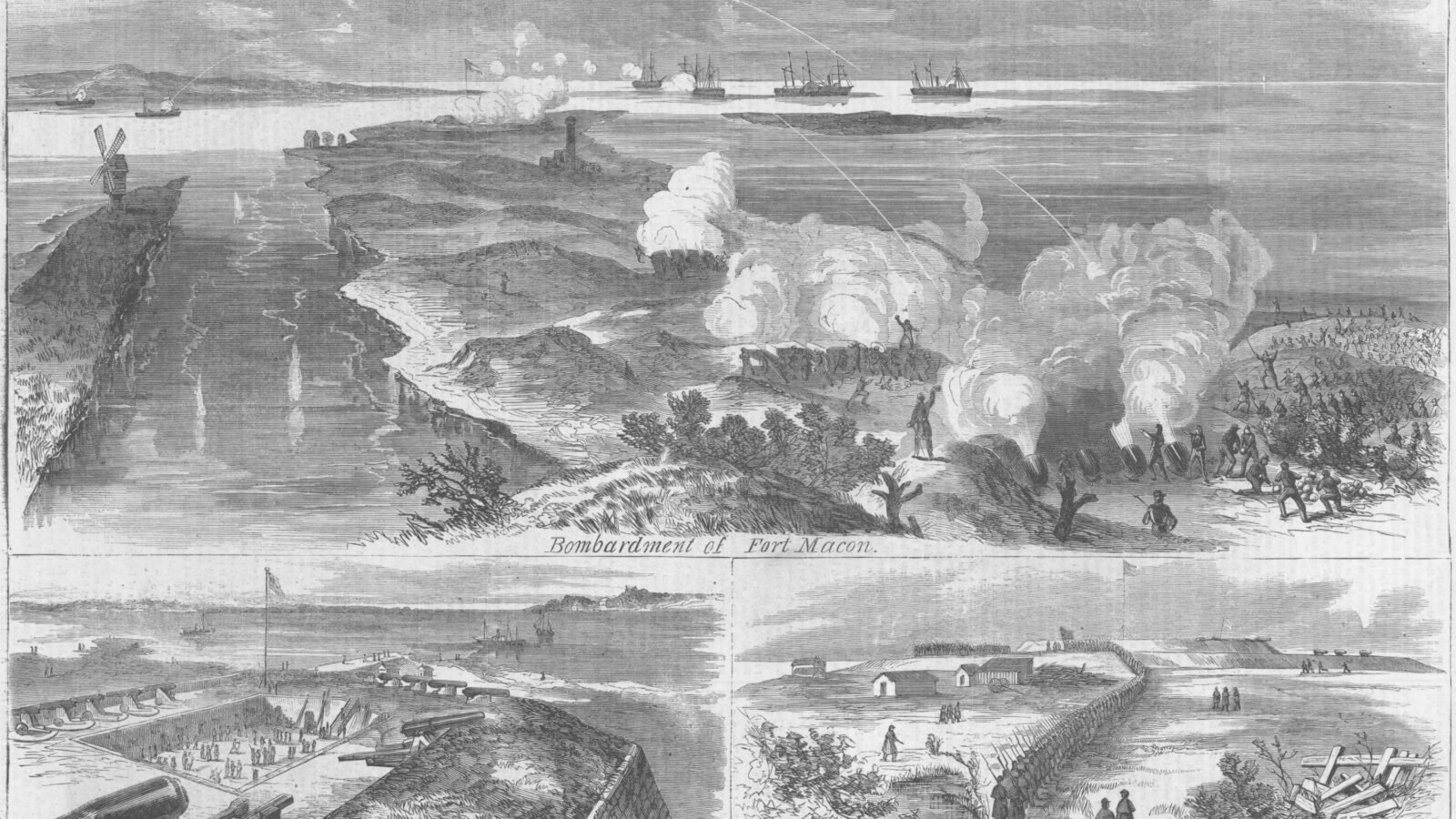
The work of building siege positions took several weeks. Union engineers and soldiers dug batteries in the sand, mounted rifled guns and mortars, and placed them within range of the fort's walls.
The bombardment and the breach
The Union batteries opened fire on April 25, 1862. Rifled guns fired at the masonry, and mortars dropped shells onto the parapets and the interior. Fort Macon's own guns answered, but they fired through very narrow embrasures and could do little damage to the siege batteries in the dunes.
By the afternoon of April 25 the walls had been breached in several places, and many of the fort's guns were out of action. Around 4:30 p.m. the Confederate garrison raised a white flag, because the commander feared the magazine would be hit and further resistance would mean more killed and wounded men.
Fort Macon's brick walls had been built before rifled artillery came into wide use. Rifled cannon fired at close, accurate ranges broke through that masonry, and the attack showed how vulnerable such masonry forts were to rifled artillery.
Surrender and what came after
On April 26, 1862, Colonel White surrendered Fort Macon. The garrison became prisoners of war, and the Union took possession of the fort, its guns, and its stores.
Beaufort and Morehead City had already been under Union control since late March, before the siege began. The fort served as a Union garrison and base for the rest of the war, which gave Union forces a secure harbor and a supply point on the North Carolina coast.
The U.S. Army abandoned the fort in 1903. In 1924 Congress sold the fort and its reservation to North Carolina for $1, and it became a state park. Civilian Conservation Corps crews restored the fort in 1934 and 1935, and the park opened to the public on May 1, 1936.
What the stones still show
Visitors to Fort Macon State Park can tour the brick fort, which the Civilian Conservation Corps restored in the 1930s. Tours and reenactments depict life in the fort during the Civil War.
The fort is a casemated masonry work, and visitors standing inside its walls can see how close the attacking batteries in the dunes were to the fort.
Fort Macon is a reminder that the forts built before the Civil War were designed for a different kind of attack. The bombardment of April 25, 1862, lasted about eleven hours, and it was enough to breach the walls and force a surrender the next day.
Citation information
- Article title
- Fort Macon Falls: Burnside’s Siege of the Bogue Banks Fort, April 1862
- Author
- John. H.
- Website name
- North Carolina Backstory
- URL
- https://northcarolinabackstory.com/fort-macon-falls-burnsides-siege-of-the-bogue-banks-fort-april-1862/
- Original published date
- November 16, 2026
We strive for accuracy and fairness. If you see something that doesn’t look right, contact us.