The Overmountain Men and the Victory at Kings Mountain, 1780
In the autumn of 1780, a thousand frontier riflemen crossed the Blue Ridge and destroyed a Loyalist army in about an hour, upending British plans in the South.
- When
- 1780
- Where
- Kings Mountain, South Carolina and Sycamore Shoals, Tennessee (then North Carolina)
On September 26, 1780, about a thousand men gathered on the meadows beside the Watauga River at Sycamore Shoals, in what was then the western edge of North Carolina. They carried long rifles, blankets and a little parched corn, and most had left their farms on a few days' notice. Tradition says the Presbyterian minister Samuel Doak sent them off with a sermon, though the exact words come from later retellings.
Ahead of them lay mountain gaps, early snow and a Loyalist force led by a Scottish officer. Eleven days later, on a rocky ridge just inside South Carolina, they would win one of the most lopsided battles of the Revolutionary War.
A war that moved south
By 1780 the British had shifted their main effort to the southern colonies, hoping to rally Loyalist support. General Sir Henry Clinton captured Charleston on May 12, and in August Lord Cornwallis crushed Horatio Gates's army at Camden, South Carolina. Organized Patriot resistance in the Carolinas had nearly collapsed.
Cornwallis planned to march into North Carolina. To protect his western flank and raise Loyalist militia, he relied on Major Patrick Ferguson, a 36-year-old Scot who had been wounded at Brandywine in 1777 and who had designed a breech-loading rifle. Ferguson had spent the summer drilling backcountry Loyalists and skirmishing with Patriot bands in the Carolina Piedmont.
A warning across the mountains
The settlers beyond the Blue Ridge, along the Watauga, Holston and Nolichucky rivers, were called the Overmountain men because they lived west of the mountains. Some Patriot refugees from the Piedmont, among them Colonel Charles McDowell, had fled to them for help. Isaac Shelby and John Sevier, militia leaders from the North Carolina settlements, had already fought Ferguson's outposts that summer.
Ferguson then sent a paroled prisoner, Samuel Phillips, with a message: if the mountain men did not stop resisting the Crown, he would march over the mountains, hang their leaders and devastate their country. Historians generally accept that such a warning was delivered, but the wording survives mainly in later recollections. It had the opposite of its intended effect. Shelby, Sevier and Colonel William Campbell of Washington County, Virginia, agreed to raise their men and strike first.
The march to the ridge
The force left Sycamore Shoals on September 26 and crossed the Blue Ridge at Yellow Mountain Gap, where, by some accounts, they met snow. On October 1 they reached Quaker Meadows in North Carolina and were joined by militia under Benjamin Cleveland and Joseph Winston. The officers chose Campbell as overall commander, partly because no one of higher standing was present.
Ferguson, learning that a large force was coming, fell back toward Cornwallis at Charlotte. On October 6 he camped atop Kings Mountain, a wooded, boulder-strewn ridge close to the state line. A well-known story says he boasted that God Almighty could not drive him from it. That quote is attributed to him but is not firmly documented.
At Cowpens that night, the Patriot leaders picked about 900 of their best-mounted men and rode through rain toward the ridge. They arrived the afternoon of October 7.
One hour on Kings Mountain
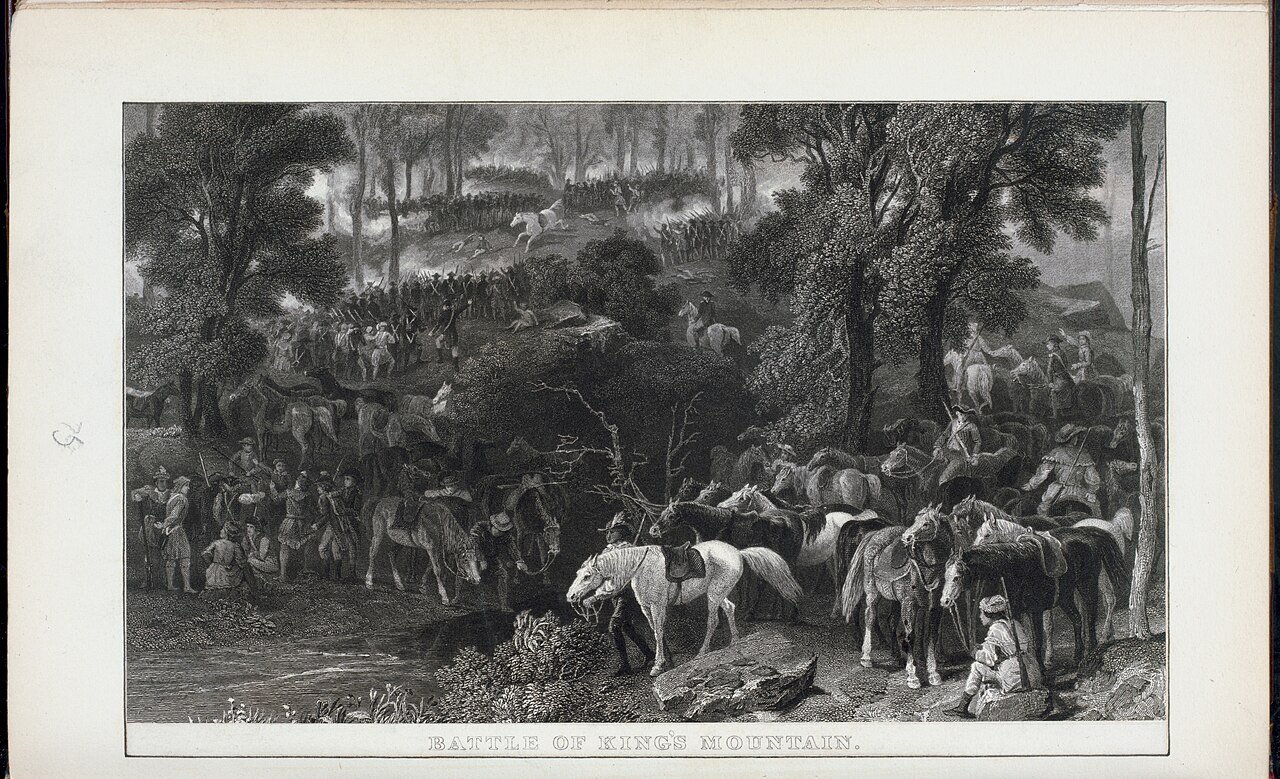
The Patriots split into columns, surrounded the ridge and climbed it from several sides, fighting from tree to tree. Ferguson's men, mostly American-born Loyalists, with a small force of provincial regulars, held the high ground. They drove back attackers with bayonet charges, but each time they returned to the summit, riflemen on another side fired into them.
The fight lasted about an hour. Ferguson was shot from his horse while trying to break out and died on the field. Campbell's report counted about 157 Loyalists killed, 163 badly wounded and some 698 captured, against 28 Patriots killed and 62 wounded. Those figures are widely quoted but are not exact.
The ending was ugly. Many Loyalists tried to surrender while Patriots, some thinking of earlier massacres by Loyalist and British forces, kept firing. A few days later, a Patriot court condemned a number of prisoners, and by most accounts nine were hanged.
What it changed
When news reached Cornwallis, he abandoned his advance into North Carolina and withdrew to Winnsboro, South Carolina. Losing Ferguson's detachment exposed his flank, and it damaged Loyalist recruiting in the backcountry. Patriot militia, who had been demoralized after Camden, took heart.
Thomas Jefferson later described the battle as a turning point, and many historians agree that it began a reversal in the South. They also point out that Cornwallis's army remained strong and invaded North Carolina in January 1781. The defeat of Banastre Tarleton at Cowpens that month, Nathanael Greene's costly campaign and Yorktown in October 1781 all followed.
Kings Mountain was unusual in another way. No Continental regulars fought there, and the Patriot force was made up entirely of militia who had organized themselves. The battlefield is now preserved as Kings Mountain National Military Park, and the Overmountain Victory National Historic Trail traces the route the men took from Sycamore Shoals.
Citation information
- Article title
- The Overmountain Men and the Victory at Kings Mountain, 1780
- Author
- admin
- Website name
- North Carolina Backstory
- URL
- https://northcarolinabackstory.com/the-overmountain-men-and-the-victory-at-kings-mountain-1780/
- Original published date
- June 9, 2026
We strive for accuracy and fairness. If you see something that doesn’t look right, contact us.