The Dismal Swamp Canal: George Washington’s Dream and the Enslaved Laborers Who Dug It
Dug by hand through a Virginia–North Carolina swamp, the Dismal Swamp Canal opened in 1805. Enslaved workers built it, and fugitives hid in the swamp around it.

- When
- 1805
- Where
- Camden County, North Carolina
By 1805, a flat-bottomed boat could travel a narrow, straight channel through the Great Dismal Swamp. The water was dark as tea, stained by the roots and bark of the trees along the banks. The channel ran about 22 miles, from the Pasquotank River side in Camden County, North Carolina, to the Elizabeth River in Virginia. It was a commercial shortcut, and it had been dug mostly by hand, largely by enslaved men standing in mud and water.
The Dismal Swamp Canal is often described as one of the oldest continuously operating artificial waterways in the United States. Its story is usually told as one of engineering and commerce. It is also a story about forced labor, and about people who used the same swamp to escape bondage.
A swamp that merchants wanted to drain
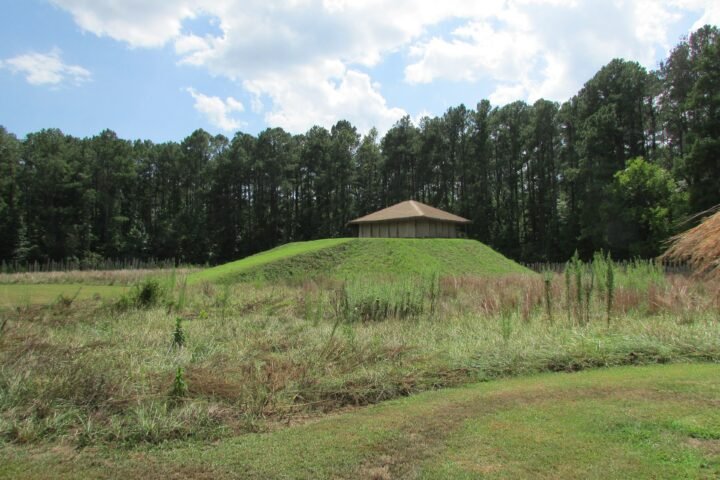
The Great Dismal Swamp once covered well over a million acres of the coastal plain on the Virginia–North Carolina line. To eighteenth-century investors it looked like wasted land and a barrier. It also held valuable timber: cypress, and the Atlantic white cedar that colonists called juniper, prized for shingles.
George Washington saw the swamp's potential early. In 1763 he took part in forming a land company to drain and log it, and he visited the area, including Lake Drummond at its center. His company dug ditches and cut shingles using enslaved labor. In 1795 he agreed to sell his interest to Henry Lee, but Lee could not pay and the shares later reverted to Washington's estate. Washington died in 1799, years before the canal was finished.
Why a canal mattered
The reason for a canal was geography. Goods from the Albemarle Sound region of North Carolina had to reach Norfolk, the nearest major port, by way of dangerous coastal waters and shallow inlets. An inland route through the swamp would be safer and more predictable.
Virginia chartered a Dismal Swamp Canal Company in 1787, and North Carolina followed in 1790. Digging began in 1793. The canal carried shingles, lumber, and farm products, and a feeder ditch from Lake Drummond supplied it with water.
The title's link to Washington needs care. He promoted the idea of draining the swamp and of a navigable link through it, and he and Patrick Henry helped bring the canal company into being. But the canal built in the 1790s was a separate enterprise from his own company's ditches, and he did not direct its construction.
Who dug it
Most of the physical work was done by enslaved people, many of them hired out by their owners to the canal company and to the swamp's timber operations. The labor meant cutting through dense roots, digging and hauling soil, and working in standing water. Summer heat, winter cold, flooding, disease and venomous snakes were constant dangers in the swamp.
No reliable count survives of how many enslaved workers dug the canal or how many died doing it. Company and plantation records are incomplete, and the workers themselves left almost no written accounts. Later visitors, such as the journalist Frederick Law Olmsted, who toured the region in 1853 and published his account in 1856, described enslaved laborers cutting shingles in the swamp. That was decades after the canal opened, but it shows how long the system lasted.
The canal did not work well at first. It was shallow, and it was later deepened and widened over many years. The federal government took ownership in 1929, and the route later became part of the Atlantic Intracoastal Waterway.
A refuge in the same swamp
The swamp was also a hiding place. For generations, people escaping slavery went into the Dismal, and some stayed for long periods. Historians call such communities maroons. Archaeologist Daniel Sayers and others have studied sites on the swamp's higher ground that point to people living there, apart from the plantation world around them.
How many people lived in the swamp is uncertain. Some scholars have suggested thousands over the colonial and antebellum periods, but those figures are estimates, and the population probably changed over time. Some fugitives also worked at the edges of the swamp's economy.
Writers took up the swamp as a symbol. Henry Wadsworth Longfellow published "The Slave in the Dismal Swamp" in 1842, and Harriet Beecher Stowe set her 1856 novel Dred there. These were literary works, not documentary evidence, but they show that the swamp's role as a refuge was widely known.
What the canal left behind
The canal's opening in 1805 helped tie the Albemarle region more closely to Norfolk's markets. It also linked the region's wealth to coerced labor. The channel through Camden County is still used today by boaters.
That makes the canal an unusual monument. The waterway Washington's generation wanted was dug by people who were not free, through a landscape where other people had gone to be free.
Sources
- 091 – Nation’s Oldest Artificial Waterways > U.S. Army Corps of Engineers Headquarters > Fact Sheets View (usace.army.mil)
- NPS Form 10-900-b (Jan. 1987) 0MB No. 1024-0018 MAR P 81988 (npgallery.nps.gov)
- Dismal Swamp Canal (virginiaplaces.org)
- Dismal Swamp Company (mountvernon.org)
- Deep in the Swamps, Archaeologists Are Finding How Fugitive Slaves Kept Their Freedom (smithsonianmag.com)
- Dismal Swamp Canal (dhr.virginia.gov)
Citation information
- Article title
- The Dismal Swamp Canal: George Washington’s Dream and the Enslaved Laborers Who Dug It
- Author
- admin
- Website name
- North Carolina Backstory
- URL
- https://northcarolinabackstory.com/the-dismal-swamp-canal-george-washingtons-dream-and-the-enslaved-laborers-who-dug-it/
- Original published date
- October 22, 2026
We strive for accuracy and fairness. If you see something that doesn’t look right, contact us.