Biltmore: George Vanderbilt’s Mountain Estate and the Birth of American Forestry
George Vanderbilt's Asheville château opened on Christmas Eve 1895. Its woodlands became a testing ground for American forestry and its first forestry school.
- When
- 1895
- Where
- Asheville, Buncombe County, North Carolina
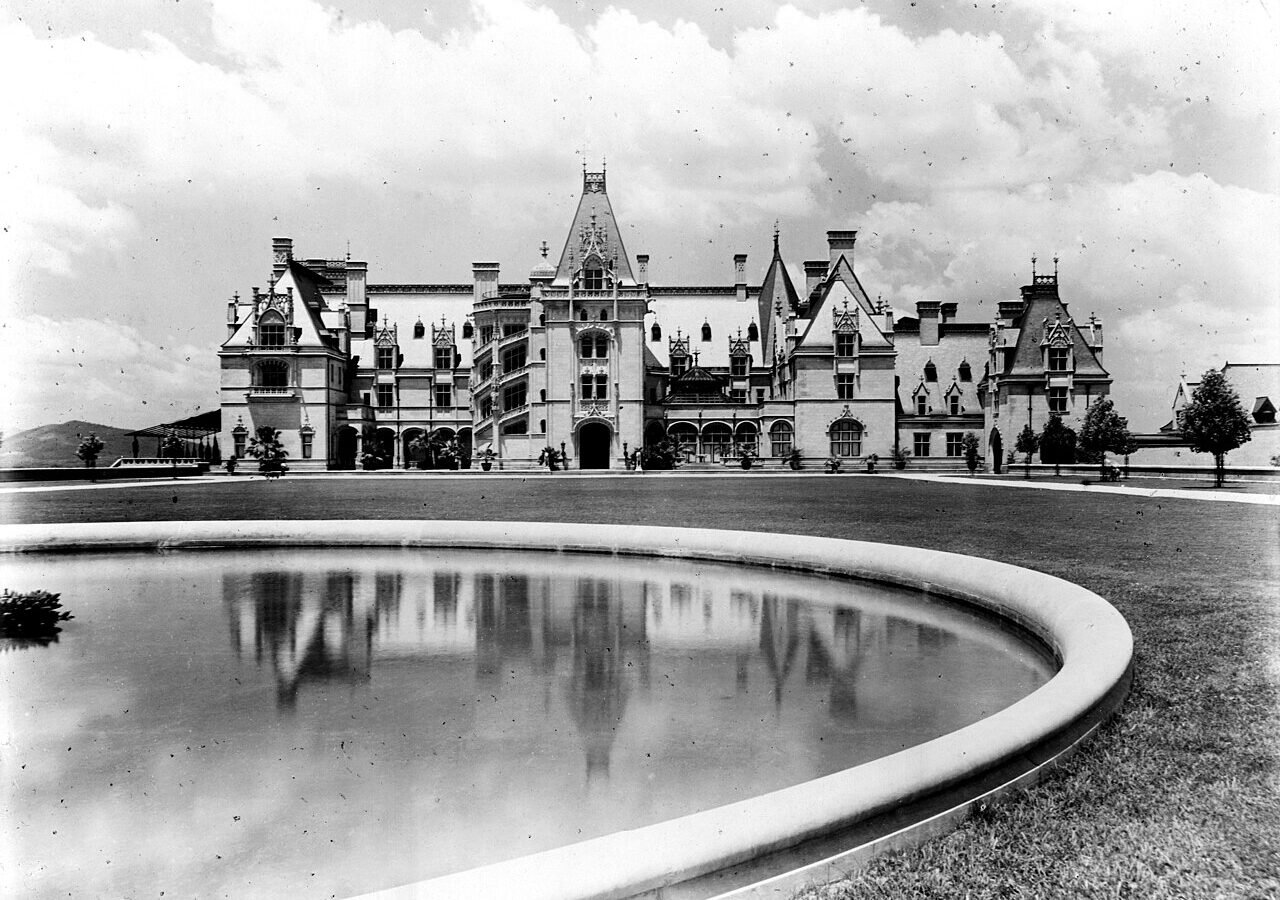
On Christmas Eve 1895, George Vanderbilt welcomed family and friends to a house that had taken about six years to build and was still not entirely finished. Biltmore House, a limestone château with roughly 250 rooms, stood on a rise near the French Broad River, just south of Asheville, North Carolina. It remains the largest privately owned home in the United States.
The house drew the attention, but the land around it mattered more to history. On that worn-out mountain acreage, three men worked out ideas about how Americans might use forests without destroying them. Their work helped start professional forestry in the United States.
A château in the mountains
George Washington Vanderbilt II, born in 1862, was the youngest child of William Henry Vanderbilt and a grandson of Cornelius Vanderbilt. He first visited the Asheville area in the late 1880s and liked the climate and the views. In 1888 he began buying farms and woodlots, and he eventually assembled about 125,000 acres.
For the house he hired Richard Morris Hunt, the New York architect who had designed mansions for other Vanderbilts. Hunt drew on the châteaux of France's Loire Valley. Builders brought in Indiana limestone and other materials over a railway spur built for the job. Hunt died in July 1895, a few months before the house opened.
Olmsted's case for the forest
Vanderbilt asked Frederick Law Olmsted, the designer of Central Park, to plan the grounds. Olmsted, then in his late sixties, found land that had been farmed hard and logged carelessly. He designed a long approach road that leads visitors through woods before the house comes into view. He also planned gardens and a park near the house.
His most unusual advice concerned the rest of the property. Olmsted urged Vanderbilt to manage the larger area as a working forest, with careful cutting and replanting, rather than turn it all into pleasure grounds. He also recommended a young forester for the job. Olmsted's health failed in the mid-1890s, and he retired in 1895.
Pinchot's experiment
Gifford Pinchot was born in 1865 and graduated from Yale in 1889. He then studied at the French forestry school in Nancy. Vanderbilt hired him in 1892 to manage the Biltmore forest. At the time, most American timber was simply cut, with little thought for regrowth.
Pinchot surveyed the stands and planned selective cutting. He also showed the results in an exhibit at the 1893 World's Columbian Exposition in Chicago. Whether the forest made money is disputed. Pinchot later spoke of it as a success, but other accounts, including Schenck's, suggest Vanderbilt put in far more money than the forest returned. Pinchot left in 1895. He later led the federal Division of Forestry and became the first chief of the U.S. Forest Service in 1905.
Schenck and the Biltmore Forest School
Carl Alwin Schenck, a German forester born in 1868, took over the Biltmore forest in 1895. He found that American forestry had few trained workers, so he began taking apprentices. In 1898 he formalized this as the Biltmore Forest School. Students spent a year learning in the woods, with field work, lectures and practice in measuring and logging timber. The school later used the Pisgah Forest tract and sometimes took students to Germany.
The school is usually called the first forestry school in the United States. That claim needs a caveat. Cornell University's forestry college also opened in 1898, and historians disagree about which came first. Schenck was dismissed by Vanderbilt in 1909, partly over costs and partly over disagreements. The school carried on for a few more years and closed in 1913.
What lasted
Vanderbilt died in March 1914. His widow, Edith, agreed to sell about 87,000 acres of the Pisgah area to the federal government. The sale became the core of Pisgah National Forest, established in 1916. It was among the early purchases made under the Weeks Act of 1911, which allowed the government to buy forest land in the eastern states.
The house survived as well. Biltmore opened to the public in 1930, and the estate today covers roughly 8,000 acres. The old forestry school site, now called the Cradle of Forestry in America, lies in Pisgah National Forest near Brevard.
Citation information
- Article title
- Biltmore: George Vanderbilt’s Mountain Estate and the Birth of American Forestry
- Author
- admin
- Website name
- North Carolina Backstory
- URL
- https://northcarolinabackstory.com/biltmore-george-vanderbilts-mountain-estate-and-the-birth-of-american-forestry/
- Original published date
- September 18, 2026
We strive for accuracy and fairness. If you see something that doesn’t look right, contact us.