The Gettysburg Address, November 19, 1863: Lincoln’s Two Minutes and the Cemetery That Left the Confederate Dead Out
On November 19, 1863, Lincoln spoke for about two minutes at a cemetery built for Union dead. The Confederate dead of Gettysburg were left out, and their remains were moved south later.
- When
- 1863
- Where
- Gettysburg, Adams County, Pennsylvania
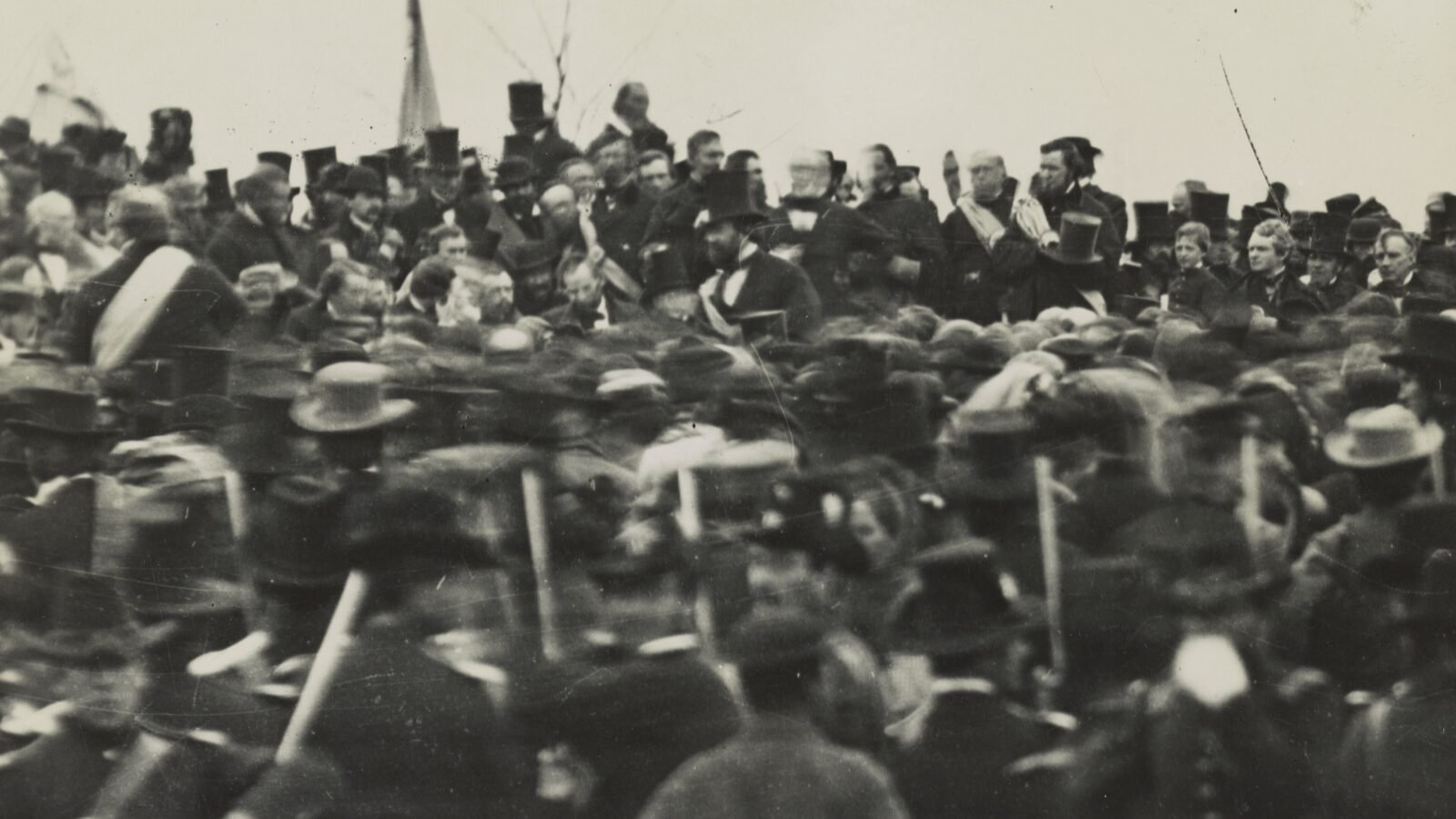
For almost two hours on November 19, 1863, the crowd at Gettysburg listened to Edward Everett, one of the best-known orators in the country, walk through the battle day by day. When he finished, Abraham Lincoln stepped forward with a short text in hand. He spoke for only a few minutes.
The speech was Abraham Lincoln's address at the Soldiers' National Cemetery. It runs about 270 words in its best-known texts, and it became one of the most quoted pieces of American prose. It also says almost nothing about the men who were buried around the speakers' platform, and nothing at all about the men who had fought against them.
Two hours, then two minutes
The dedication was organized by David Wills, a Gettysburg attorney whom Pennsylvania Governor Andrew Curtin had appointed to acquire land for the cemetery. Lincoln was invited to attend and accepted. He stayed at Wills's house, where he finished the address.
Everett spoke first, as the program required. His oration reviewed the course of the battle over the three days of fighting in July 1863, and it ran nearly two hours. Lincoln followed with a speech that was far shorter and much plainer in its language.
The next day Everett wrote to Lincoln that he hoped he had come as near to the central idea of the occasion in two hours as Lincoln had in two minutes. Lincoln's text opened with the line "Four score and seven years ago our fathers brought forth on this continent, a new nation, conceived in Liberty, and dedicated to the proposition that all men are created equal."
A cemetery for one army
The Soldiers' National Cemetery was laid out on the hills south of town. The Union dead had been buried in shallow graves across the field, and the cemetery was created to gather them into one plot and rebury them in order by state.
The cemetery was for Union soldiers only. More than 3,500 Union dead were eventually buried there, and many of them could not be identified. The Confederate dead were not part of the plan, and no Confederate soldier was buried in its rows.
Lincoln's speech reflected the same focus. He spoke of the "brave men, living and dead, who struggled here," and of the work of "those who here gave their lives that that nation might live." He did not name the Confederate dead, and he did not mention the armies that had fought against the Union at Gettysburg.
The Confederate dead on the field
Confederate losses at Gettysburg were heavy. Among the regiments that suffered most was the 26th North Carolina, which was part of Pettigrew's brigade. The regiment entered the fighting on July 1 and took part again in the assault of July 3. It lost more than half of the roughly 800 men it carried into the battle, and its colonel, Henry King Burgwyn Jr., was killed.
After Lee's army withdrew on July 4 and the following days, the Confederate dead remained in shallow and individual graves across the battlefield, often near where they fell. Burial was uneven, and torrential rain on July 4 unearthed some shallow graves. Union burial parties worked to identify and inter both friend and foe in the weeks after the battle.
In the early 1870s, Southern memorial associations and families began removing Confederate remains and sending them south for reburial. Many went to Hollywood Cemetery in Richmond. Some were reinterred in cemeteries in their home states, but the scale of the removals and the locations involved are harder to document in full. The cemetery in Gettysburg that Lincoln dedicated stayed a Union burial ground.
Why the two minutes still matter
Newspaper reports of Lincoln's speech appeared in print, including Associated Press and Boston Advertiser accounts. Over the following decades it became the document most people associate with Gettysburg, even though the battle itself was defined by the men who fought and died on both sides.
What is clear is that the text does not mention the Confederate dead buried across the fields, the North Carolina regiments that fought there, or the families who would later come to reclaim their own.
Citation information
- Article title
- The Gettysburg Address, November 19, 1863: Lincoln’s Two Minutes and the Cemetery That Left the Confederate Dead Out
- Author
- John. H.
- Website name
- North Carolina Backstory
- URL
- https://northcarolinabackstory.com/the-gettysburg-address-november-19-1863-lincolns-two-minutes-and-the-cemetery-that-left-the-confederate-dead-out/
- Original published date
- November 20, 2026
We strive for accuracy and fairness. If you see something that doesn’t look right, contact us.