Lewis Hine’s Camera in the Carolina Mills: Child Workers Photographed for a National Audience
Around 1908 to 1912, Lewis Hine photographed child workers in Southern cotton mills for the National Child Labor Committee. What his pictures show, and what they leave out.
- When
- 1908
- Where
- Southern cotton mill villages, including North Carolina, South Carolina and Georgia
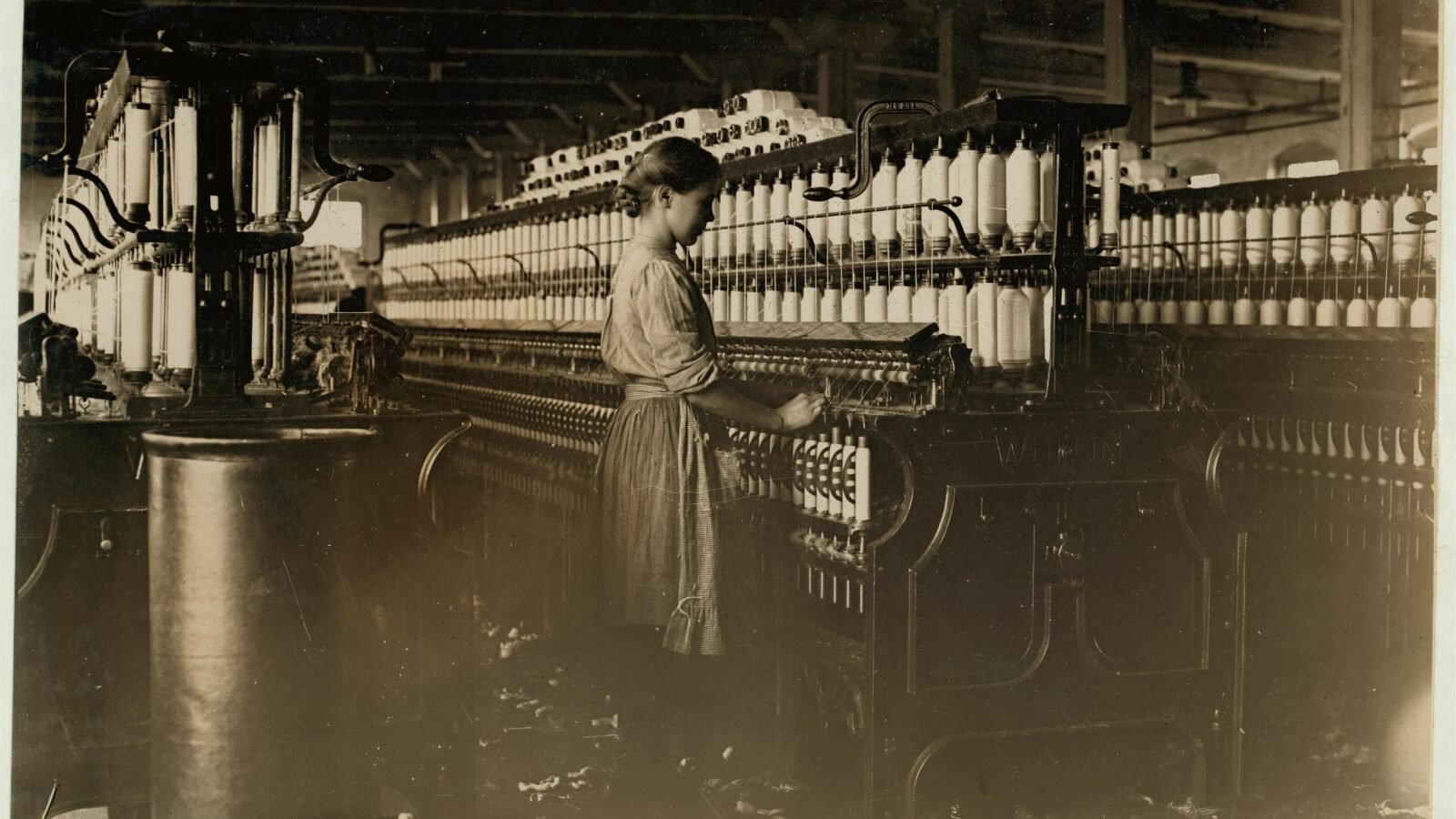
Picture a boy of about ten standing beside a spinning frame, his face level with the machinery and cotton lint on his clothes. He is looking at the camera, or perhaps at the man holding it. The photograph is sharp, and the caption beneath it gives his name, his job and a few notes about his hours.
Images like this one reached readers across the North in the years before the First World War. They were made by Lewis Wickes Hine, a former schoolteacher turned photographer, who worked for the National Child Labor Committee. The committee had been founded in 1904 to push for laws that would keep children out of factories, mines and mills.
A reformer with a camera
Hine began working for the committee in 1908, after several years of photographing immigrants and factory workers in the Northeast. His captions were typed or written to accompany each print and gave the child's age, the work performed, and how long the child had been employed, as Hine had learned it.
The committee's Southern work was led in part by Alexander J. McKelway, a Presbyterian minister and journalist who had long campaigned against child labor in North Carolina. McKelway knew the mill towns, the state officials and the mill owners who resisted reform. Hine's trips through the Carolinas and neighboring states gave the campaign visual evidence to match McKelway's testimony and speeches.
North Carolina's 1907 child labor law set thirteen as the minimum age for factory work, with apprentices allowed at twelve. Reformers argued that enforcement was weak and that many younger children were working anyway. Hine's photographs were meant to show that gap between the law on paper and the children in the rooms.
What the pictures show
Hine's mill photographs focus on the work itself: spinning, doffing, carrying bobbins and sweeping under the machines. He often positioned children next to large machines so viewers could see how small they were in comparison.
The captions add details that the images cannot carry alone. Hine often recorded that a child had worked for a year or more, or was younger than the mill claimed. Some ages in his notes were the children's own estimates, and a picture cannot confirm them. The pictures gained authority from the sense that the camera could not lie.
Hine also got into workplaces by misleading the people who ran them. Library of Congress documents say he posed as a Bible salesman or an industrial photographer, and other accounts add fire inspector and postcard seller. That approach got him into places reformers could not enter, but it also means the photographs record only what Hine was allowed to see or was able to catch.
What the pictures leave out
The photographs say little about money. A family's wages, the cost of rent and the company store, and the reasons a parent sent a child into the mill are mostly missing. A child who looks idle in a frame may have been waiting for a machine to be fixed, and a picture cannot show that. The pictures also rarely show the mill owners, managers or the state officials who set policy.
Race is a major gap. The mill photographs show only the children Hine was able to photograph inside those mills, and they say nothing about child labor done by Black children in fields, tobacco warehouses or domestic work.
The mill records that would test the captions are limited. Historians who want to test Hine's captions have to look to state labor reports, such as those issued by the North Carolina Bureau of Labor Statistics, created in 1887 and renamed the Bureau of Labor and Printing in 1899, along with newspaper coverage and committee correspondence. Where those sources agree with Hine, his captions carry weight. Where they do not, the picture needs a qualifier.
How the images served the campaign
The committee used Hine's photographs in its publications, in lectures and at legislative hearings. The images made a single case that was hard to argue against: children were working in conditions that no decent society would want for its own young.
The campaign's legal results were mixed. Congress passed the Keating-Owen Child Labor Act in 1916, which barred interstate shipment of goods made with child labor. The Supreme Court struck it down in Hammer v. Dagenhart in 1918. A second attempt, a proposed constitutional amendment in 1924, was not ratified. Federal limits on child labor finally came with the Fair Labor Standards Act of 1938.
Hine's photographs outlasted those early fights. Today they are held in the Library of Congress as part of the National Child Labor Committee collection, and historians still use them. Read carefully, they show the work and the faces of children at a particular moment, along with the limits of what one photographer could record.
Citation information
- Article title
- Lewis Hine’s Camera in the Carolina Mills: Child Workers Photographed for a National Audience
- Author
- Dylan Thomas
- Website name
- North Carolina Backstory
- URL
- https://northcarolinabackstory.com/lewis-hines-camera-in-the-carolina-mills-child-workers-photographed-for-a-national-audience/
- Original published date
- November 21, 2026
We strive for accuracy and fairness. If you see something that doesn’t look right, contact us.