Black Mountain College: The Experimental School That Changed American Art
In a small North Carolina valley, a tiny college put the arts at the center of education and drew artists who reshaped American culture.
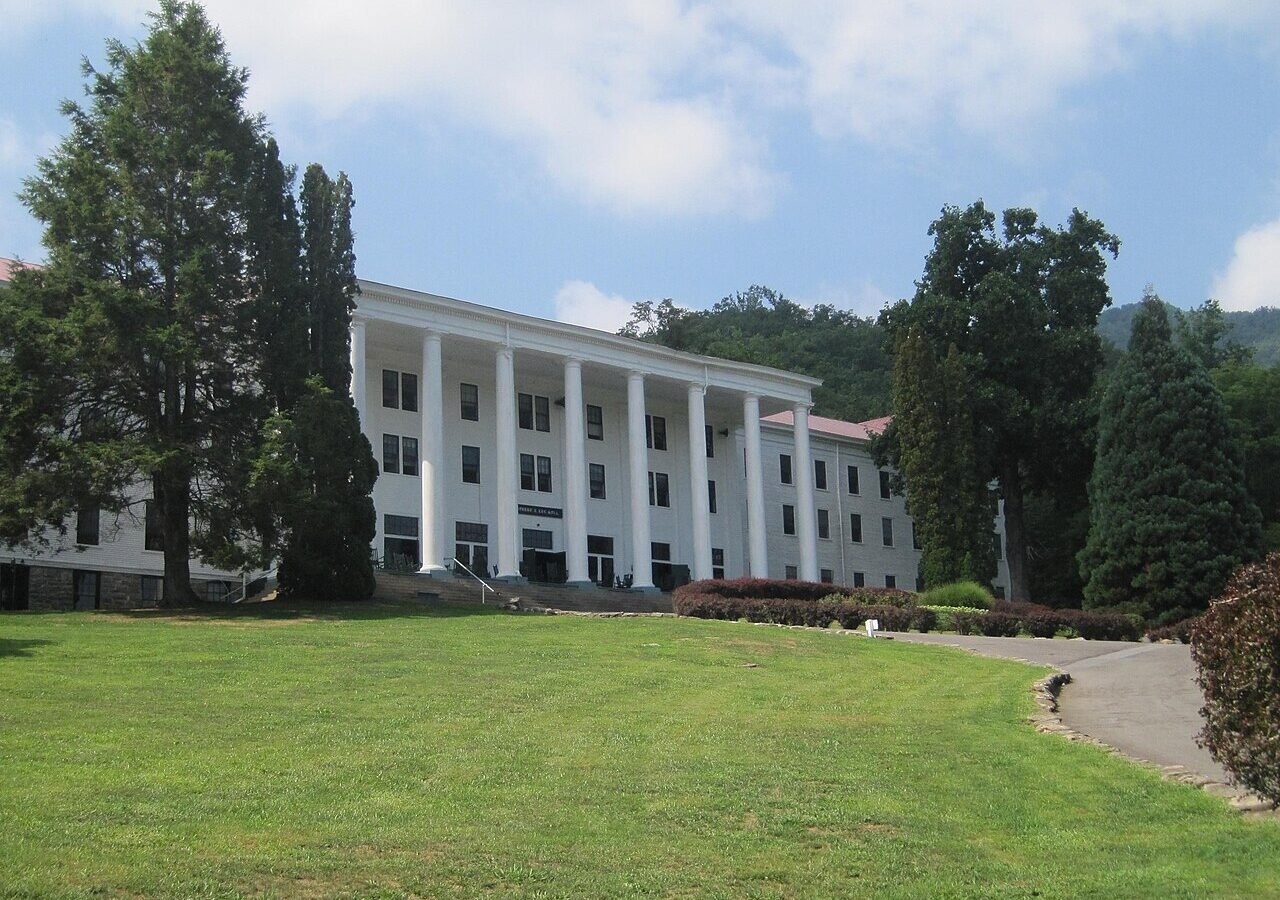
- When
- 1933
- Where
- Black Mountain, Buncombe County, North Carolina
One evening in the summer of 1952, a small audience sat in the dining hall at Black Mountain College, in the mountains of western North Carolina. Above them hung white paintings by a young student named Robert Rauschenberg. Around them, according to later accounts, a record player, a film, a piano, poems, and the dancer Merce Cunningham moving through the aisles all competed for attention at once.
No one filmed the event, and the people who were there remembered it differently. What is certain is that the college where it happened was one of the most unusual schools in American history, and that its small community had an outsized effect on modern art, music, dance and poetry.
A school built by teachers who were fired
Black Mountain College began with a dispute over who should control a college. John Andrew Rice, a classics professor, was dismissed from Rollins College in Florida in 1933 after clashing with its administration. Several colleagues left with him, among them Theodore Dreier and Ralph Lounsbury, and together they decided to start a new school.
They opened in September 1933 in the Blue Ridge Mountains near the town of Black Mountain, in Buncombe County. At first they rented buildings at the Blue Ridge Assembly, a church conference center, with a few dozen students and a handful of teachers. The faculty owned and ran the college themselves, with no outside owner or conventional board of trustees directing them.
Rice was influenced by the educational ideas of John Dewey, who stressed learning through experience. He believed that the arts should sit at the center of a liberal education, not at its edge. Students were expected to practice an art, not simply study one, and to take part in running the community.
The Alberses arrive
The decisive hire came almost at once. The Bauhaus, the German school of art and design, had been closed in 1933 under Nazi pressure, and its former teacher Josef Albers needed a new post. On the recommendation of the architect Philip Johnson, Rice invited him, and Albers and his wife, the textile artist Anni Albers, reached North Carolina that November. Josef reportedly spoke very little English at the time.
Josef Albers led the art program until 1949 and taught a demanding course in seeing, color and materials. Anni Albers taught weaving and became one of the major textile artists of the century. Their students included Ruth Asawa, Kenneth Noland, Cy Twombly and Robert Rauschenberg, who studied there in 1948 and 1949.
In 1937 the college bought a new site at Lake Eden, across the valley, and moved there in 1941. The Studies Building, its main teaching hall, was built largely with the labor of students and faculty.
Summers that drew the avant-garde
The college stayed small, but its summer sessions attracted visiting artists. In the summer of 1948 the inventor and designer Buckminster Fuller came to teach. His attempt to build a dome from metal strips that summer did not hold up, an episode often retold at the college as a lesson in learning from failure. He returned in 1949, and Black Mountain remains closely tied to the early history of his geodesic domes.
The composer John Cage visited in 1948 and organized a festival of the music of Erik Satie, with Cunningham in the cast of a Satie play. Cage came back in 1952. In the summer of 1953 Cunningham gathered dancers at the college, and that group became the Merce Cunningham Dance Company. Cage and Cunningham later became lifelong partners in life and work.
Other teachers and visitors included Willem and Elaine de Kooning, Robert Motherwell, Franz Kline and, in 1946, the painter Jacob Lawrence and his wife Gwendolyn Knight.
The 1952 event and the poets
The 1952 dining-hall performance, usually called Theatre Piece No. 1 or simply the Untitled Event, is often described as an early forerunner of the 'happening.' Participants are generally said to have included Cage, Cunningham, Rauschenberg, the pianist David Tudor and the poets Charles Olson and M. C. Richards. Details such as the exact sequence of actions, the audience seating and even who did what vary from one recollection to the next, and historians treat some of the famous versions with caution.
Poetry mattered just as much. Olson, who taught at the college from 1951 and later served as its rector, helped define a school of poets now linked to the college's name. Robert Creeley edited the Black Mountain Review from 1954 to 1957, publishing Olson, Robert Duncan, Denise Levertov and others, and drawing the attention of younger writers across the country.
Closure and legacy
Black Mountain never had a large endowment, and it depended on tuition, gifts and the work of its own community. By the mid-1950s enrollment had dwindled and debts had grown. The college closed in 1957.
Its direct influence was greater than its size would suggest. Former students and teachers went on to shape abstract painting, experimental music, postwar dance, design and American poetry. Its lasting argument was that making art is not a luxury added to education but a way of learning. Today the Black Mountain College Museum + Arts Center in Asheville preserves its story.
Citation information
- Article title
- Black Mountain College: The Experimental School That Changed American Art
- Author
- admin
- Website name
- North Carolina Backstory
- URL
- https://northcarolinabackstory.com/black-mountain-college-the-experimental-school-that-changed-american-art/
- Original published date
- July 22, 2026
We strive for accuracy and fairness. If you see something that doesn’t look right, contact us.