The Battle of Hayes Pond, 1958: How the Lumbee Broke Up a Klan Rally
In January 1958, a Klan leader promised a rally against the Lumbee of Robeson County. Hundreds of Lumbee showed up first, and the night ended in a rout.
- When
- 1958
- Where
- Maxton, Robeson County, North Carolina
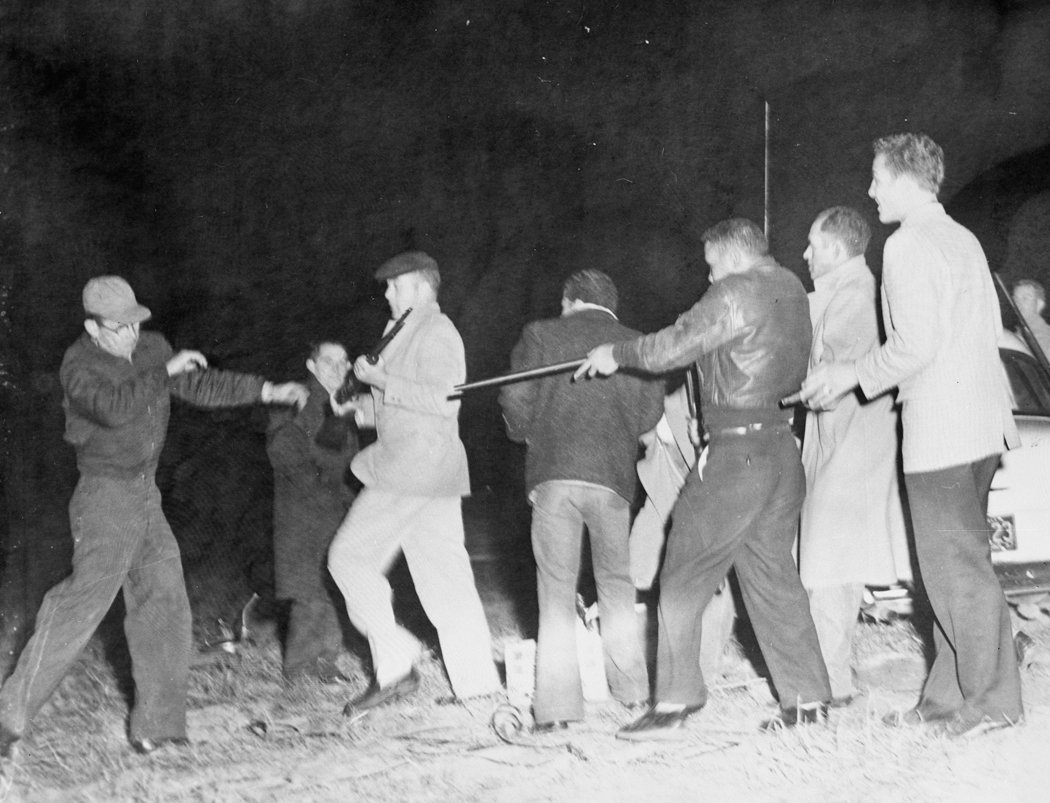
On the night of Saturday, January 18, 1958, a small group of Ku Klux Klansmen stood in a field outside Maxton, North Carolina. They had a public address system and a single light bulb strung up to light the rally. Around them, in the dark, stood hundreds of Lumbee men, women and children, many of them armed.
Then someone shot out the bulb. Within minutes the Klan's rally had turned into a retreat, and the story of the night had begun to spread well beyond Robeson County.
A county with three peoples
Robeson County, in southeastern North Carolina, was unusual in the Jim Crow South. Its population was divided among white, Black and American Indian residents, and it kept three separate school systems. The Indian population, roughly 30,000 people in the 1950s, is now known as the Lumbee, a name taken from the Lumber River that runs through the county.
The name was fairly new. The state of North Carolina had recognized the group as the Cherokee Indians of Robeson County in 1913, over the objection of the Eastern Band of Cherokee. In 1953 the legislature changed the name to Lumbee, and in 1956 Congress passed the Lumbee Act. That law acknowledged the Lumbee as Indians but withheld the benefits and services that come with federal recognition, a limit that remains a grievance today.
Lumbee history also includes a tradition of armed resistance. In the 1860s Henry Berry Lowrie led a band that fought the Confederate authorities and the Home Guard in what is called the Lowry War, and he remains a folk hero in the county. Many Lumbee men in 1958 had also served in the military in World War II or Korea.
Catfish Cole comes to Robeson
James W. "Catfish" Cole, of Marion, South Carolina, led a Klan organization in the Carolinas. He was one of many rival Klan leaders of the 1950s, when the movement was fragmented and looking for new causes after the Supreme Court's 1954 ruling in Brown v. Board of Education.
Cole focused on Robeson County and on the Lumbee, whom he attacked for supposed race mixing. Crosses were burned in the county in the weeks before the rally. One was left at the home of Sibbie Brewington Locklear, a Lumbee woman who was reported to be involved with a white man. Cole then announced a rally for January 18 in a field near Hayes Pond, a few miles from Maxton, and predicted a large turnout.
The night of January 18
The Lumbee did not wait to be told what would happen. Word of the rally spread through the community, and people began gathering around the field before the Klansmen arrived. Accounts differ on the size of the crowd, with estimates running from several hundred to a thousand or more. Cole had talked of thousands of Klansmen, but historians generally put the number who came at somewhere between fifty and a hundred.
A small force of law officers, including Robeson County Sheriff Malcolm McLeod and state highway patrolmen, was also on the scene. They were badly outnumbered. When the Klan's single light was shot out, the crowd closed in, and gunfire was exchanged. The Klansmen ran, leaving behind their sound equipment, banners and other gear. Cole himself fled and, according to most accounts, hid in a swamp.
The fighting was brief and the casualties were light. A few Klansmen were reported injured, and there were no deaths. The Lumbee celebrated in the field afterward, some of them wearing captured Klan regalia.
Press, prosecution and memory
The confrontation was reported across the country. Life magazine published a photograph of two Lumbee men, Simeon Oxendine and Charlie Warriax, holding a captured Klan banner. The image became the best-known picture of the event.
North Carolina officials did not defend the Klan. Governor Luther Hodges condemned Cole's campaign, and Cole was charged and convicted of inciting a riot. His organization did not recover its standing in the state.
Within the Lumbee community, the night is remembered as the Battle of Hayes Pond and is often marked with anniversary events. The event is a source of pride, but it is also tied to a political fight. Lumbee leaders have long asked Congress for full federal recognition, and the 1956 law's restriction has made that request the central issue of Lumbee politics in the decades since.
The confrontation did not end racism in Robeson County, and it was not a large-scale war. It showed, however, that a community that had often been left out of the South's racial binary could defend itself, and that a Klan leader's boasts could fall apart in the face of organized opposition.
Citation information
- Article title
- The Battle of Hayes Pond, 1958: How the Lumbee Broke Up a Klan Rally
- Author
- admin
- Website name
- North Carolina Backstory
- URL
- https://northcarolinabackstory.com/the-battle-of-hayes-pond-1958-how-the-lumbee-broke-up-a-klan-rally/
- Original published date
- July 24, 2026
We strive for accuracy and fairness. If you see something that doesn’t look right, contact us.