Blackbeard’s Last Stand at Ocracoke Inlet, 1718
In November 1718 a Virginia-funded force cornered Blackbeard in Ocracoke Inlet. The fight ended his career and exposed a feud between two colonies.
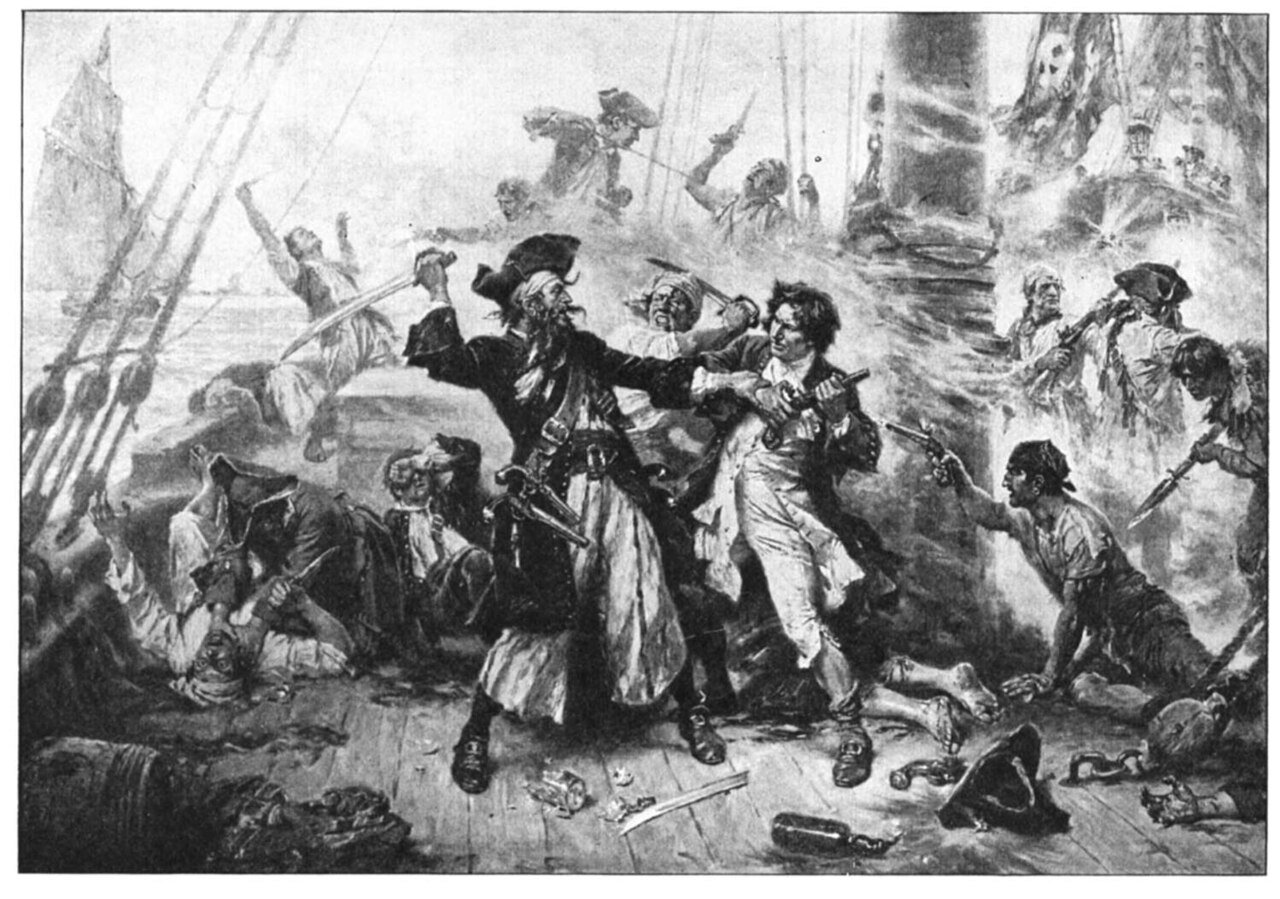
- When
- 1718
- Where
- Ocracoke Island, Hyde County, North Carolina
On the morning of 22 November 1718, two small sloops felt their way into Ocracoke Inlet on the Outer Banks. Lt. Robert Maynard of the Royal Navy was in command. Ahead of him, anchored behind the shoals, lay the sloop Adventure and the most famous pirate in the Atlantic, Edward Teach, known to history as Blackbeard.
Within hours Teach was dead. His severed head hung from the bowsprit of Maynard's sloop, which was bound for Virginia. The fight is often told as a tale of one pirate's defiance, but it was also a political act. A governor sent armed men into a neighboring colony's waters to do what that colony had not done.
A pirate with a pardon
Teach was probably born in or near Bristol, England, and his surname appears as both Teach and Thatch. He is first documented as a privateer during Queen Anne's War, then as a lieutenant to the pirate Benjamin Hornigold in the Bahamas. In November 1717 he captured a French slave ship near Martinique and turned it into his flagship, Queen Anne's Revenge, with about forty guns.
In May 1718 Teach blockaded Charleston, South Carolina, and held hostages until the town handed over a chest of medicine. Soon afterward the Queen Anne's Revenge ran aground at Beaufort Inlet, North Carolina. Historians disagree about whether this was an accident or a calculated way to shed crew and shrink the plunder shares. Teach kept a smaller vessel, the Adventure.
He then went to Bath, the small capital of North Carolina, and accepted the king's pardon from Governor Charles Eden. The pardon came from the Act of Grace of 1717, which forgave piracy committed before a set date. Teach kept the Adventure and made Ocracoke his base.
Spotswood takes matters into his own hands
Alexander Spotswood, the lieutenant governor of Virginia, saw Teach as a threat to Virginia's tobacco trade. He also distrusted the arrangement in North Carolina. Eden's secretary, Tobias Knight, was suspected of dealing with Teach, and Spotswood believed the colony was giving pirates a safe harbor.
Spotswood chose not to wait for North Carolina to act. He hired two sloops, the Jane and the Ranger, and put Maynard in charge, drawing his men from the warships HMS Pearl and HMS Lyme. Virginia also offered rewards for pirates, with a larger sum for Teach himself. Spotswood was sending a force into another colony's jurisdiction without its governor's consent, and later critics said so.
The fight in the shallows
Maynard left the James River area in mid-November and reached Ocracoke on the 21st. By the traditional account he waited for daylight, since the channels were too tricky to enter at night. Our main sources are Maynard's own report and Charles Johnson's A General History of the Pyrates, published in 1724. Johnson wrote with a novelist's flair, so his details deserve caution.
Teach had the heavier armament and opened fire when the sloops closed in. Shot killed or wounded many of Maynard's men, and the Ranger was put out of action early. Johnson says Maynard ordered most of his crew below to bait Teach into boarding. When Teach's men came over the side, the hidden crew rose up and the fight became a hand-to-hand struggle on the deck.
Maynard and Teach fought each other directly. Johnson says Teach took five gunshot wounds and some twenty sword cuts before he fell. Johnson also says the body was thrown overboard and swam around the ship, which is a legend. Maynard's force took heavy casualties, and most of Teach's remaining men were killed or captured.
Aftermath and the wreck
Maynard sailed to Virginia with Teach's head on the bowsprit. The captured crewmen were tried at Williamsburg in early 1719, and sources commonly say thirteen were hanged. Israel Hands, who had been wounded earlier, was reportedly spared by news of a pardon. Maynard and his men later argued with Spotswood over how the reward money should be divided.
The Carolina episode also showed how thin colonial authority on the coast was. Piracy was a problem, but so was the lack of any shared policy among colonial governors. The Royal Navy's growing presence and Woodes Rogers's governorship of the Bahamas, which began in 1718, did more to end the pirate era in the Atlantic than any single battle.
In November 1996 a private research firm, Intersal, located a wreck about a mile off Fort Macon, in shallow water at Beaufort Inlet. Research and recovery since then, led by the state of North Carolina, have brought up cannon, anchors, and a ship's bell, among many other objects. The wreck is widely accepted as the Queen Anne's Revenge. The state's conservation lab continues to study the finds, and many are displayed at the North Carolina Maritime Museum in Beaufort.
Citation information
- Article title
- Blackbeard’s Last Stand at Ocracoke Inlet, 1718
- Author
- admin
- Website name
- North Carolina Backstory
- URL
- https://northcarolinabackstory.com/blackbeards-last-stand-at-ocracoke-inlet-1718/
- Original published date
- April 16, 2026
We strive for accuracy and fairness. If you see something that doesn’t look right, contact us.