Currituck Beach Light, December 1875: Filling the Last Dark Stretch of the Atlantic Coast
In December 1875 a brick tower on the northern Outer Banks began shining over a long, dangerous stretch of coast. Keepers would wind its clockwork by hand for more than sixty years.
- When
- 1875
- Where
- Corolla, Currituck County, North Carolina
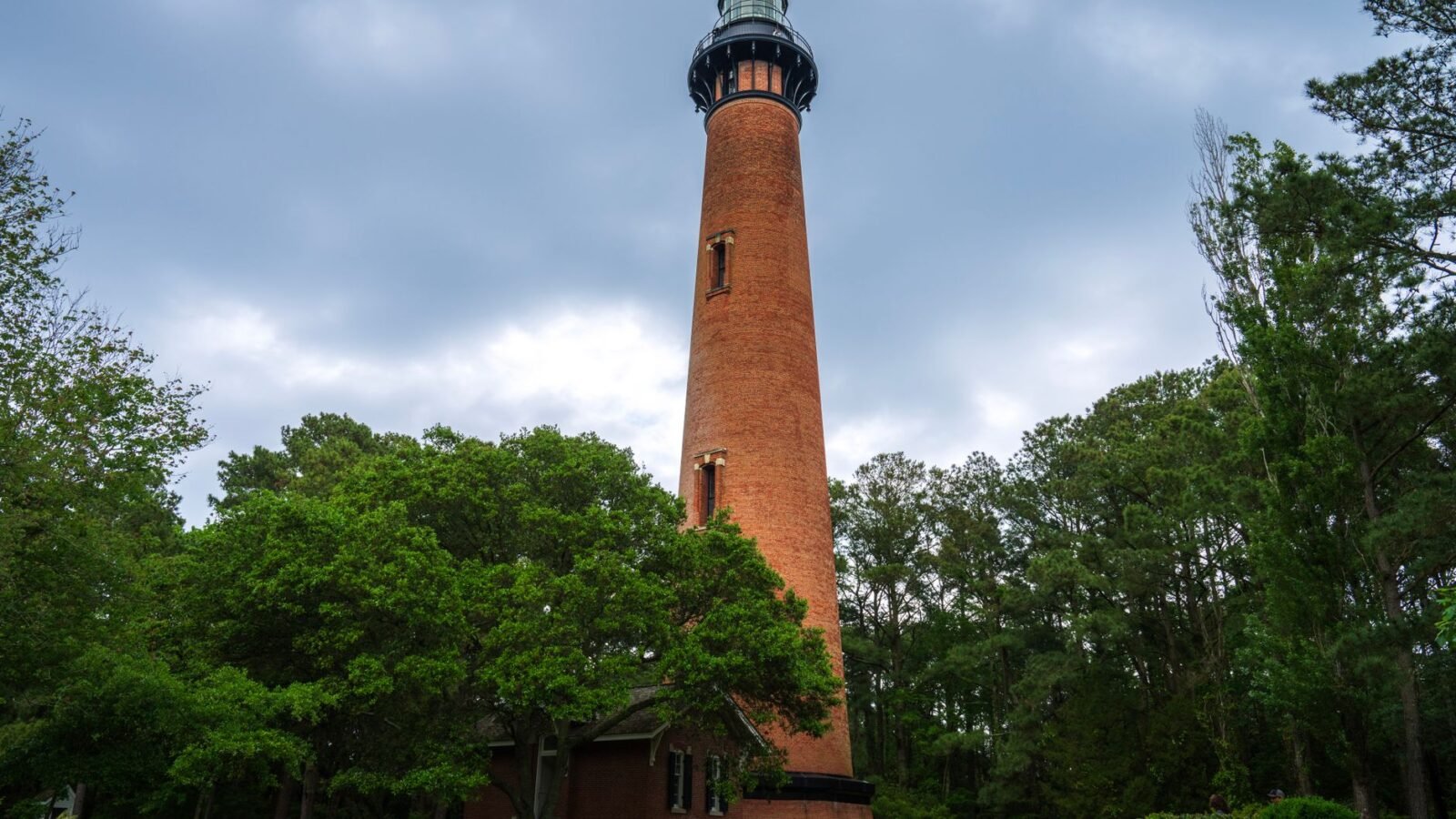
On the afternoon of December 1, 1875, a Lighthouse Board lampist climbed a spiral staircase inside a new brick tower on the sand dunes of northeastern North Carolina and lit the lamp for the first time. Once night fell, ships out past the breakers could see it from miles away, a fixed white light where there had been only darkness for a long stretch of the Atlantic seaboard.
The tower still stands at Corolla, in Currituck County. It is 162 feet tall, and it has never been painted. Its brick walls show their natural color, which sets it apart from many other lighthouses of its era.
A coast with a hole in its lights
By the early 1870s, the Outer Banks had earned a fearsome reputation among sailors. Shifting shoals, strong currents and storms pushed vessels onto the sand, and wrecks were common enough that the Outer Banks came to be widely known as the Graveyard of the Atlantic.
The federal government had already built or rebuilt several lights along the coast. Between the lights at Cape Henry, at the mouth of Chesapeake Bay, and Bodie Island, south of Currituck Sound, there was a long run of coast with no light at all. Sources commonly describe this gap as about 40 miles.
Ships passing through that stretch had no fixed light to check their position against at night.
Congress pays for a tower
The U.S. Lighthouse Board, which managed the nation's lights from Washington, proposed a tower for the Currituck site in 1872. Congress approved money for the tower in 1873. Sources differ on when work began: some give 1873 and others give 1874.
Building a tall masonry tower on a barrier island was slow, expensive work. Materials were brought in by water, and construction used a steam pile-driver. The tower was finished in 1875.
The decision to leave the brick unpainted was deliberate. Many lighthouses were whitened or banded in daymarks that helped sailors identify them by day. Currituck was left unpainted so that mariners could tell it apart from its neighbors by day, and it kept its plain brick exterior.
The first light
The lamp was lit for the first time on December 1, 1875. Its Fresnel lens gathered and concentrated the light from the lamp into a beam that could be seen far out to sea. According to the keepers' journal, the district lampist lit the lamp that first day.
Lighting the tower closed one of the most obvious gaps in the coast's navigation system. Mariners who had sailed blind through the stretch could now take a bearing from a fixed light. The light did not end every wreck on this coast, but it gave ships a fixed reference where none had existed before.
The Lighthouse Board operated the light under the Treasury Department until 1903, when the board was moved to the Department of Commerce and Labor.
Winding the clock by hand
A Fresnel lens does not turn by itself. Keepers at Currituck, as at most lights of the period, depended on a clockwork mechanism driven by heavy weights that descended through the tower. Keepers had to crank these weights back up to the top of the tower at intervals, so the lens kept turning and its flashes stayed regular.
The work was constant. Keepers trimmed wicks and cleaned and polished the lens. A keeper who let the clockwork run down could leave the light unready for the sailors who depended on it.
The Lighthouse Service was folded into the U.S. Coast Guard in 1939. That year the light was automated, and the mechanical routine that had shaped keepers' days for more than sixty years came to an end. The tower continued to serve as a navigation aid after keepers left.
Citation information
- Article title
- Currituck Beach Light, December 1875: Filling the Last Dark Stretch of the Atlantic Coast
- Author
- admin
- Website name
- North Carolina Backstory
- URL
- https://northcarolinabackstory.com/currituck-beach-light-december-1875-filling-the-last-dark-stretch-of-the-atlantic-coast/
- Original published date
- November 14, 2026
We strive for accuracy and fairness. If you see something that doesn’t look right, contact us.