December 17, 1903: The Wright Brothers’ First Flights at Kill Devil Hills
On a freezing morning in 1903, two Ohio bicycle makers flew four times on the Outer Banks. Here is how they got there and how a lifesaver took the photo.
- When
- 1903
- Where
- Kill Devil Hills, Dare County, North Carolina
Shortly after 10:30 on the morning of Thursday, December 17, 1903, Orville Wright lay face-down on the lower wing of a spruce-and-muslin machine at the foot of a sand hill on North Carolina's Outer Banks. A wind of 20 miles per hour or more was blowing from the north, and puddles left by earlier rain had frozen overnight. The brothers had hung out a signal to bring the men of the nearby Life-Saving Station to help and to watch.
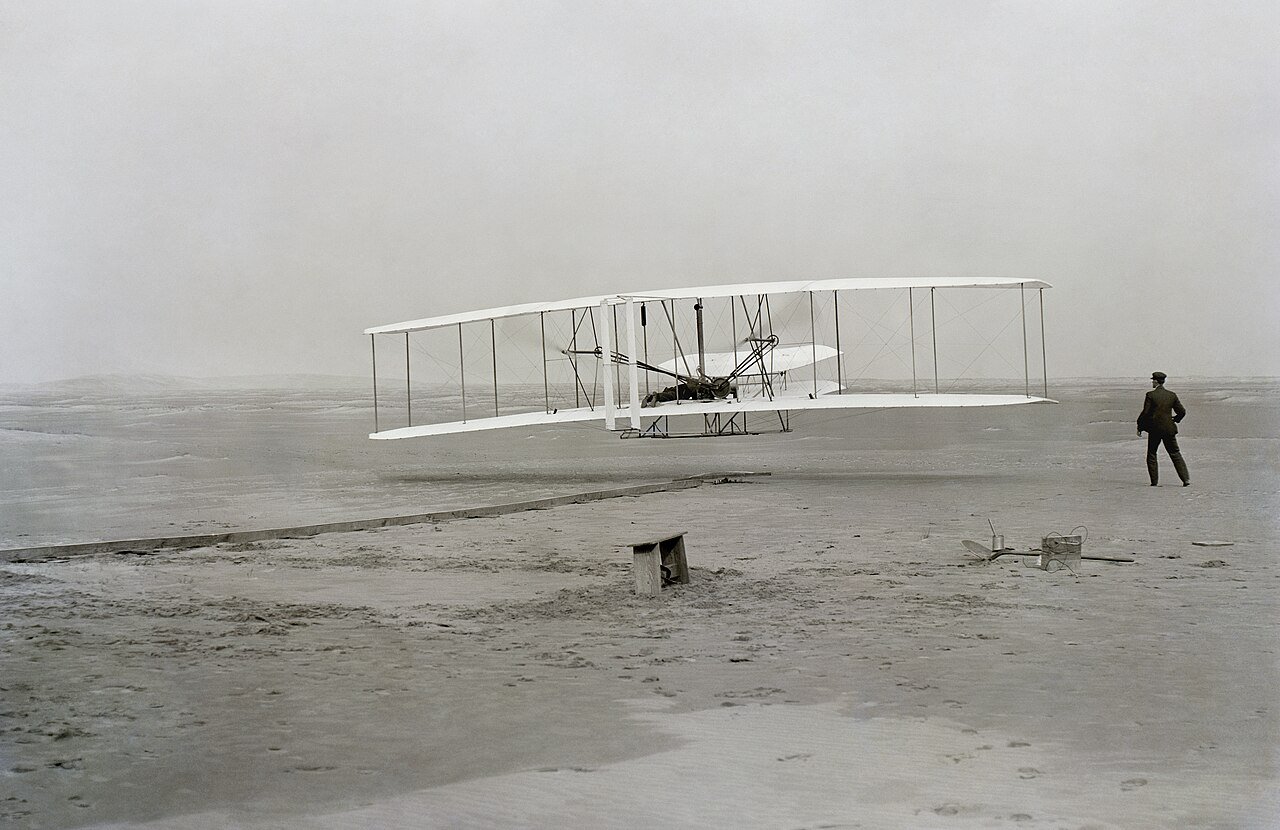
At about 10:35, Orville released the restraining wire. The machine rolled down a 60-foot wooden track, rose into the wind, and landed about 12 seconds later, roughly 120 feet from where it had left the rail. It was the first sustained, controlled, powered flight of a heavier-than-air machine carrying a pilot.
Why they chose the Outer Banks
Wilbur and Orville Wright were bicycle makers and repairers in Dayton, Ohio. They had no college degrees and no government funding. By 1899 they were studying the problem of flight, and they decided the hardest part was control, not lift or power.
In May 1900 Wilbur wrote to the U.S. Weather Bureau asking for places with steady, strong winds and open ground. He also corresponded with Octave Chanute, the engineer and glider enthusiast. William J. Tate, a Kitty Hawk resident, answered Wilbur's inquiry and described a flat, sandy, thinly settled stretch of coast.
The location had three advantages. Steady winds helped a glider stay aloft. Soft sand made crashes less dangerous. The remote setting also kept visitors and reporters away. In 1901 the brothers moved their camp about four miles south of the village to the Kill Devil Hills, where large dunes gave them room for glides. That is why the flights are tied to Kitty Hawk's name even though they took place in what is now the town of Kill Devil Hills.
Gliders, a wind tunnel and a homemade engine
Their first two gliders, flown in 1900 and 1901, produced less lift than published data had predicted. Rather than give up, the brothers built a small wind tunnel in their Dayton shop in the fall of 1901. They tested a large number of wing shapes, reportedly more than 200, and used the results to design a better wing.
Their 1902 glider combined wing-warping, which twisted the wings to control roll, with a movable rudder. It made hundreds of glides at Kill Devil Hills and gave the brothers a workable system of control in three axes. They also treated a propeller as a rotating wing and designed their own, because no suitable theory or data existed.
For power, they turned to Charlie Taylor, the mechanic in their Dayton shop. Taylor built a light four-cylinder engine in about six weeks. It produced roughly 12 horsepower and drove two propellers by chain. The completed Flyer had a wingspan of just over 40 feet and weighed about 605 pounds without its pilot.
Four flights in one morning
The brothers reached the Outer Banks in September 1903, and delays followed, including problems with the propeller shafts. On December 14, Wilbur won a coin toss for the first attempt. The Flyer climbed too steeply, stalled and settled into the sand with minor damage. The Wrights did not count it as a successful flight.
Three days later it was Orville's turn. Besides the brothers, five people were present: John T. Daniels, Adam Etheridge and Will Dough of the Life-Saving Station, Manteo businessman W. C. Brinkley, and a local teenager, Johnny Moore.
The second flight, with Wilbur at the controls, covered about 175 feet. Orville's second turn was about 200 feet. Wilbur then flew the fourth and last flight of the day at around noon. It covered 852 feet over the ground in 59 seconds. Because of the headwind, the distance the Flyer traveled through the air was considerably greater.
Soon afterward, a gust caught the parked Flyer and tumbled it across the sand. Daniels was caught up in the wreckage and bruised. The machine was badly damaged and never flew again.
The photograph
The best-known picture of the day shows the Flyer just after liftoff, with Orville prone on the wing and Wilbur at the side. It was taken by John T. Daniels, who by his own later account had never used a camera. Orville had set up the camera, a large glass-plate model on a tripod, and aimed it at the spot where he expected the machine to leave the ground. Daniels was told to squeeze the rubber bulb when the Flyer rose.
The result is a sharp, well-composed image. It records the first flight, the 12-second one, not the longest. It is also the only photograph of a powered Wright flight on that date that is widely known.
What came next
That afternoon Orville sent a telegram to their father, Bishop Milton Wright, in Dayton. It reported four flights and gave the longest as 57 seconds, a figure that differs from the 59 seconds in the brothers' later accounts. News coverage of the flights was thin and in places inaccurate, and many people doubted the claims.
The brothers returned to Ohio and kept working at Huffman Prairie, near Dayton. On October 5, 1905, Wilbur flew about 24 miles in just over 39 minutes in an improved Flyer. By then the machine could turn, circle and land under control. The 1903 Flyer itself spent years in a British museum because of a dispute with the Smithsonian Institution. It came home in 1948 and is now at the National Air and Space Museum in Washington.
Citation information
- Article title
- December 17, 1903: The Wright Brothers’ First Flights at Kill Devil Hills
- Author
- admin
- Website name
- North Carolina Backstory
- URL
- https://northcarolinabackstory.com/december-17-1903-the-wright-brothers-first-flights-at-kill-devil-hills/
- Original published date
- September 29, 2026
We strive for accuracy and fairness. If you see something that doesn’t look right, contact us.