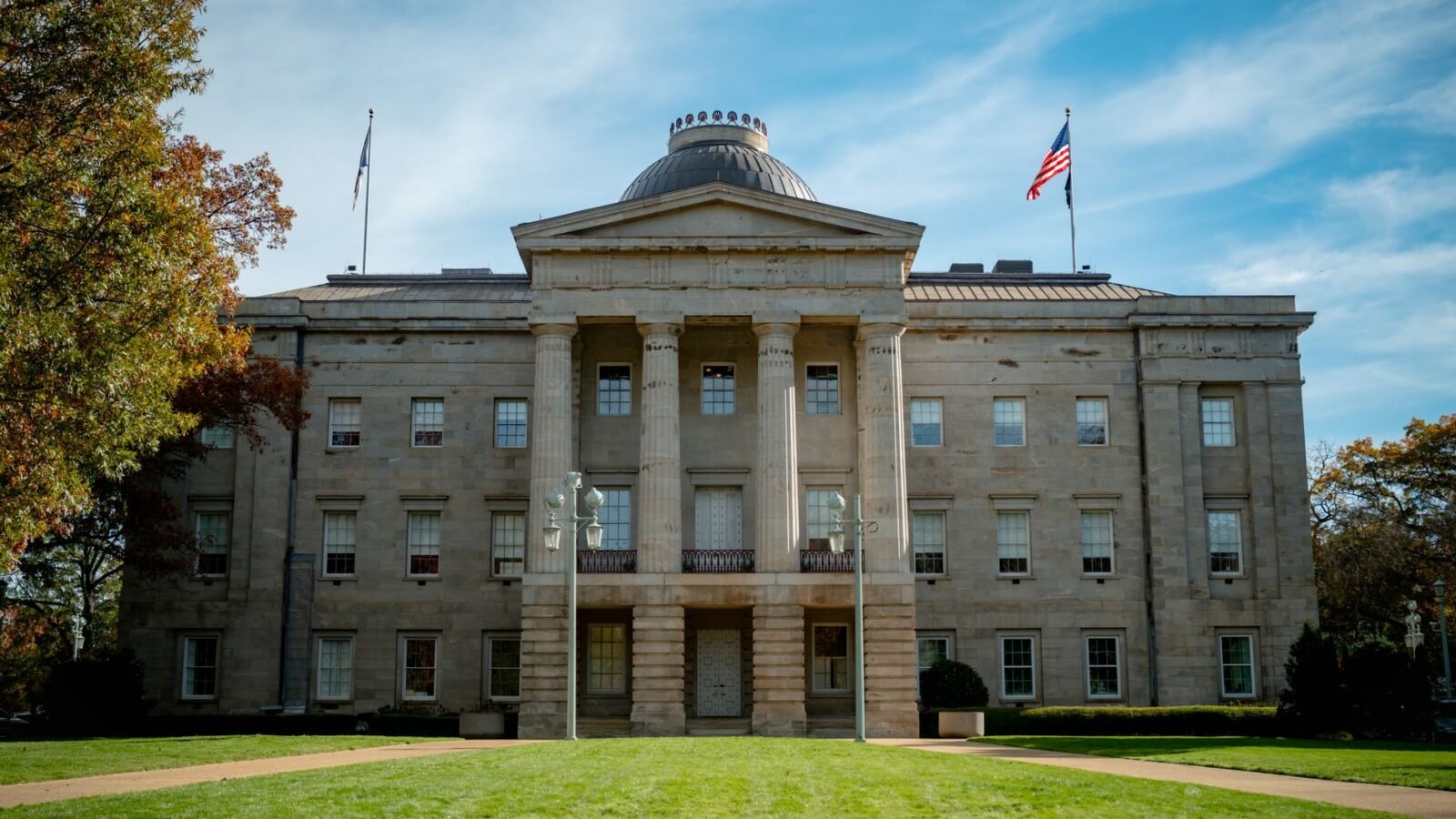
The State Capitol in Raleigh, 1840: Building the Greek Revival Statehouse
Raleigh's Greek Revival capitol opened in 1840, five years after North Carolina rewrote its constitution's voting and representation rules in 1835. Here is how the building came together and what it has meant since.
- When
- 1840
- Where
- Raleigh, Wake County, North Carolina
Legislators who entered the new State Capitol in Raleigh in late 1840 walked into a Greek Revival building with Doric columns modeled after the Parthenon. The state had spent years arguing about how it should be governed, and in 1835 it changed its constitution.
The new State Capitol replaced a state house that burned in 1831. Construction began in 1833, before the 1835 convention met, and the building was finished in 1840. It still stands on Union Square, the central square of the city's original plan.
A state that had outgrown its government house
Raleigh became the state capital in the 1790s, when the legislature moved inland from New Bern. For several decades the state's government worked out of a single State House, which burned in 1831. The General Assembly then ordered a new capitol built in 1832 and 1833.
The 1835 constitutional convention, which met in Raleigh from June to July, changed the state's constitution in several ways. It set Senate districts by the taxes each county paid and eliminated the property qualification for holding office. It also provided for the governor to be elected by the voters rather than chosen by the legislature, and it took the vote away from free Black men. The first popular gubernatorial election took place in 1836.
Town and Davis, and a Greek Revival plan
The capitol was first designed by Ithiel Town and Alexander Jackson Davis, partners in a New York architectural firm. Town and Davis specialized in a dignified Greek Revival style, but their temple-form design was not the one built. Commissioners chose a domed, cruciform scheme by William Nichols Jr., and the final design came from a sequence of work by Nichols, Town and Davis, and David Paton.
The building is cruciform in plan, with a central rotunda crowned by a copper dome. Its legislative chambers sit on a raised level behind porticoes of Doric columns. Davis never visited Raleigh during construction. The working drawings were produced by David Paton, whom Town and Davis sent in 1834 to supervise the stonework, and Paton took over the project in 1835.
Labor, stone and a slow build
Construction began in 1833 with a cornerstone laying on July 4, and the work took the better part of seven years. Local enslavers rented out the labor of enslaved men, who worked as general laborers and quarrymen, and the state paid those enslavers for the work. Over 130 enslaved African Americans worked on the project. The 1834 Report of the Commissioners lists the workers by name, and the State Capitol's research project has identified many of the enslaved men.
Money was a constant pressure. The completed building cost $532,682.34, more than three times the state's yearly general income at the time. The capitol was finished in 1840, and the legislature first met in it on November 16, 1840.
A working government building
From the start, the capitol was a working building. It housed all of North Carolina's state government until 1888, and the General Assembly met there until 1961. Its House chamber was the site of the 1861 Secession Convention.
The capitol also stood at the center of public life in the city. It occupies Union Square, the central square of the 1792 plan. During the Civil War, Raleigh women met in its rotunda to make uniforms, haversacks and bandages, and the building served as a supply depot.
Surviving the decades and becoming a symbol
The capitol came through the Civil War without being destroyed when Union forces occupied Raleigh in the spring of 1865. Renovations and restorations over the decades have changed parts of its interior and furnishings, though its exterior remains close to its 1840 appearance. Today it operates as a historic site with tours and also houses government offices.
Today the capitol is a National Historic Landmark. Its survival preserves a physical record of the government that operated under the 1835 constitution, a reminder that the state's government was built in stone and plaster as well as in statutes.
Citation information
- Article title
- The State Capitol in Raleigh, 1840: Building the Greek Revival Statehouse
- Author
- admin
- Website name
- North Carolina Backstory
- URL
- https://northcarolinabackstory.com/the-state-capitol-in-raleigh-1840-building-the-greek-revival-statehouse/
- Original published date
- November 13, 2026
We strive for accuracy and fairness. If you see something that doesn’t look right, contact us.