Erwin Mills and the Making of a Durham Textile Town
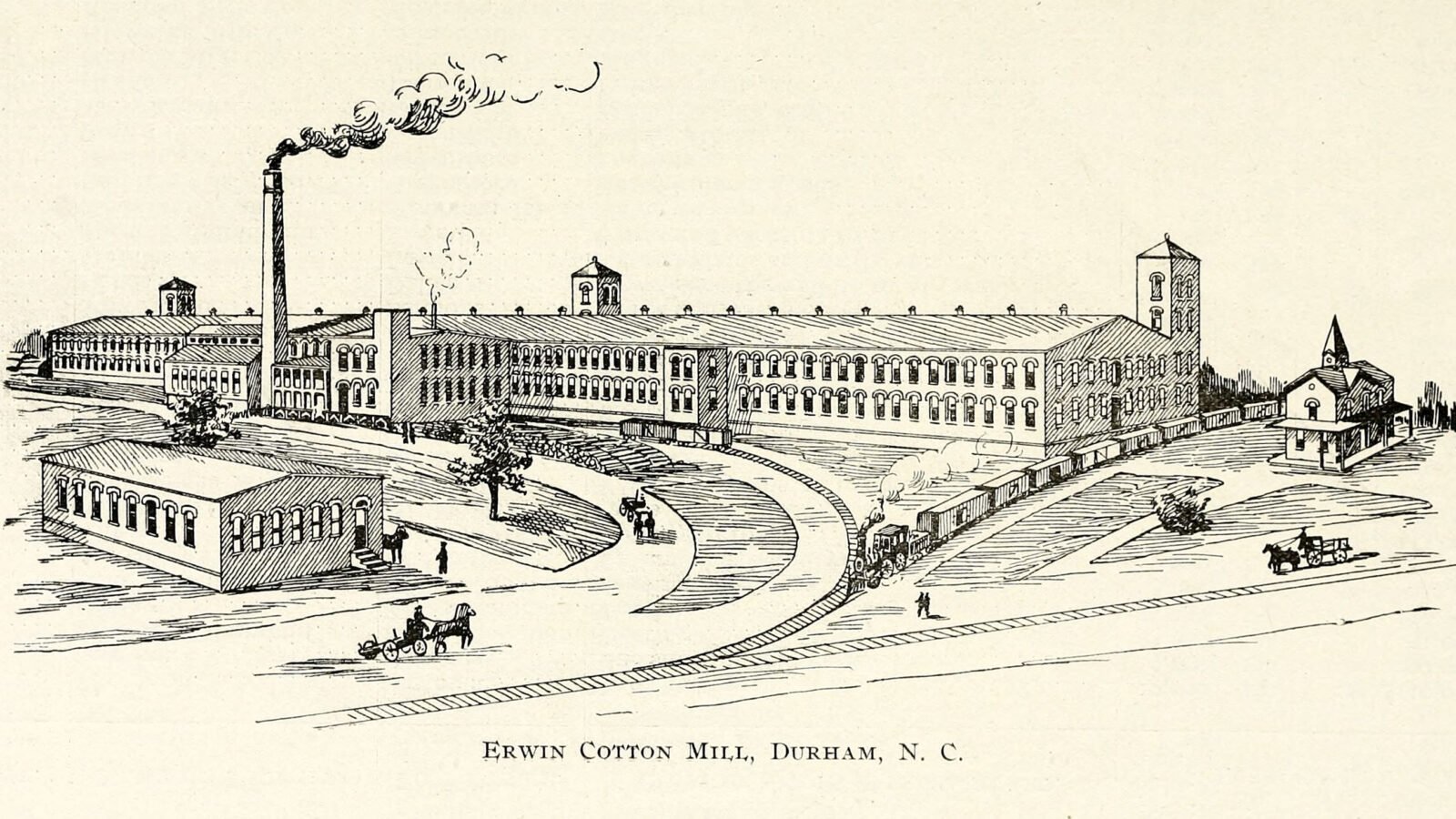
In 1892 Benjamin N. Duke and George W. Watts backed a new cotton mill on Durham's western edge, with William Allen Erwin as its manager, and the village that grew around it shaped the city for decades.
- When
- 1892
- Where
- Durham, Durham County, North Carolina
In 1892, Durham was a city that ran on tobacco. Its best-known factories rolled and packaged cigarettes and smoking tobacco, and its fortunes were tied to the Duke family and the brand names that made Durham known across the country. That year, Benjamin N. Duke and George W. Watts put up the capital for a company to build a cotton mill on the city's western edge, with William Allen Erwin as its manager. It was a different kind of industry for a town that had not yet tried it on a large scale.
The venture would become one of the largest textile operations in North Carolina. It also created a company village that housed, employed and, to a degree, schooled the people who worked its looms. The story of Erwin Mills is a useful counterweight to the familiar account of Piedmont textile towns, because in Durham the mill grew up beside a city already powered by another industry.
A tobacco city looks to cotton
Durham was incorporated in 1869, and the railroad and the tobacco trade drove its growth through the 1870s and 1880s. Washington Duke and his sons turned hand-rolled tobacco into a national business, and their factories made the city a magnet for workers from the surrounding countryside.
Cotton was the other great Piedmont industry. Mills in Alamance County, including the E. M. Holt Plaid Mills run by the Holt family, had shown that textile manufacturing could work in the region, and William Allen Erwin had managed those mills before coming to Durham. The 1892 venture in Durham followed that pattern.
Durham's textile history therefore began as a second line of industry layered onto a city whose identity was tobacco. That mix shaped how the mill operated, how its workers lived and how its owners were connected to the wider business community.
Organizing the company and the village
The company was organized as the Erwin Cotton Mills Company, capitalized at $125,000 when it was incorporated in 1892. Benjamin N. Duke served as president, George W. Watts as vice president, and William Allen Erwin as secretary-treasurer and general manager. Erwin put up $40,000 of the capital, and the Dukes and Watts provided the rest. The partnership combined Durham tobacco money with the experience of a manufacturer who had run the Holt family's Alamance mills.
The mill was built on land in West Durham, and the company also laid out housing for its workers. Like other mill villages in the South, the company owned the houses and rented them to employees. A company store and St. Joseph's Episcopal Church grew up alongside the mill, so that many of the village's needs could be met close to the plant.
Company villages gave owners a degree of control over the daily lives of their workers. They also gave families housing close to work, which many rural migrants needed. The arrangement benefited both sides, and it also left workers dependent on a single employer for income and shelter.
Housing, schooling and daily life
Erwin's company took an active role in schooling. William Allen Erwin helped secure a public graded school in West Durham, which a friend described in a biographical sketch as the first of its kind outside town limits supported wholly by the public school fund. Erwin was also known for refusing to employ underage children.
Workers rented company houses built in rows radiating from the mills, and they shopped at the company store. The village's character came from these arrangements as much as from the machinery.
A major employer into the twentieth century
Over the following decades the Erwin operation expanded beyond its first mill. Mill No. 4 was built in 1909-10 next to the original plant in West Durham, and the company added more housing there. By the early twentieth century the company employed about 1,600 people in Durham alone, making it one of the city's major employers.
The company's later history is part of a broader consolidation in the textile industry. Erwin Mills was eventually absorbed into Burlington Industries, a North Carolina textile company, though sources differ on the year, which is given variously as 1962, 1963, 1968 or 1970. In 1986 Burlington sold the original West Durham plant to J.P. Stevens, which closed it.
Erwin Mills matters because it shows how a city already known for one industry added another. The village, the mill and the families who worked there are a reminder that Durham's economic history was built as much by cotton as by cigarettes.
Citation information
- Article title
- Erwin Mills and the Making of a Durham Textile Town
- Author
- Melissa Claire
- Website name
- North Carolina Backstory
- URL
- https://northcarolinabackstory.com/erwin-mills-and-the-making-of-a-durham-textile-town/
- Original published date
- November 22, 2026
We strive for accuracy and fairness. If you see something that doesn’t look right, contact us.